Why citizen participation is essential for the survival of any climate strategy

Climate action has moved beyond technocratic debates and is now the terrain for outright political struggle. The international landscape is dominated by well-funded economic actors with a clear interest in delaying the climate transition as long as possible. From fossil fuel lobbyists to the current US administration, these actors have shown not only how easily hard-won progress can be dismantled, but also how power can be used to lock other countries in continued fossil-fuel dependency.
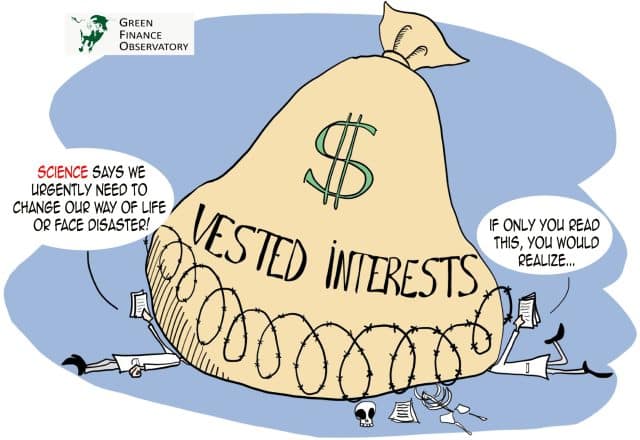
From Green Finance Observatory
In this hostile environment, climate strategies that are not politically resilient are quickly discarded. Attacks on climate policies are coming from many fronts, from registered lobbying to coordinated media campaigns. In the EU, the so-called ‘Omnibus’ package – heavily pushed by large business groups, particularly with US links – has introduced broad deregulation in the name of competitiveness, ‘trumping’ the European Green Deal. In Germany, a disinformation campaign against heat pumps, orchestrated by fossil fuel interest groups and pushed via influential media outlets, ran a peak of 20 critical articles per day, leading to a significant drop in installations.
To counter these powerful interests, institutional actors who want to implement a resilient climate strategy have one decisive advantage: public legitimacy. Climate strategies backed by a majority of citizens and a healthy, organised civil society can withstand attacks from fossil-fueled authoritarianism and are far more likely to survive political cycles.
What are the conditions for a resilient climate strategy?
So, a resilient climate strategy (or any transformative policy) needs not only to be scientifically sound, but politically viable. This means:
- Broad public support. A climate strategy with justice, equality and redistribution at its core can gain the legitimacy needed across society to resist pressures from elite-backed interest groups. This support is key to prevent situations such as the gilets jaunes movement in France, where climate measures were broadly perceived as imposing costs on the poorest, leading to massive protests.
- A strong civil society. Enabling citizens to self-organise can lead to improved disaster response, as we saw after the 2024 floods in Valencia, as well as being an antidote to authoritarianism, like the mutual aid networks that sprang up in Minneapolis in response to ICE raids. Citizen groups can also provide the backbone for broader resilience measures, such as energy cooperatives, community gardens or water conservation infrastructure.
- Localised economy. Reducing dependency on external investors and fragile supply chains (exemplified by the global disruptions caused by the closing of the strait of Hormuz) can be achieved by investing in the local economy. This also ensures that profits, skills and capacity remain within local areas, countering phenomena like delocalisation and rural flight.
When a climate strategy has been broadly legitimised and supported by a healthy civil society, with reliable funding and supply chains, it becomes resilient to political cycles.
Embedding citizen participation within climate strategies
Yet, none of these conditions emerge overnight. Local governments need to build them over time, ensuring that citizens can participate in public decisions as co-owners and contribute to their implementation.
A long-term climate resilience strategy with clear steps, roles, and feedback processes ensures that citizens and other groups can more easily take ownership of elements of it, even if authorities lose the resources, capacity or political will to execute it.
Climate KIC’s Regional Resilience Journey, tested across over 100 regions, offers an example of embedding citizen participation within climate planning. Its building a shared vision phase ensures that citizens are meaningfully consulted and engaged to explore possible futures, uncover positive narratives around climate resilience, and define together what a just transition should look like for their region.
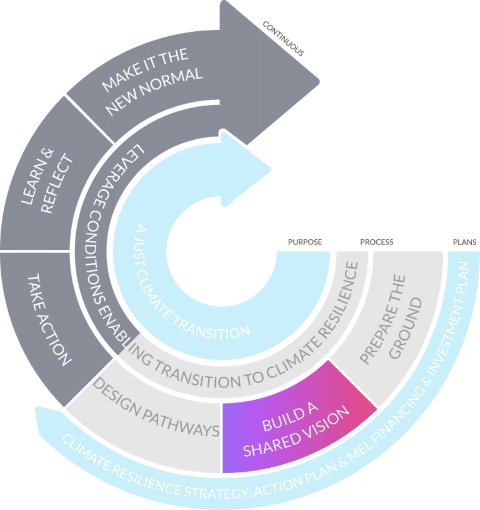
Regional Resilience Journey framework with emphasis on the shared vision phase.
A co-created vision can mobilise communities while holding institutions accountable. Citizens are more likely to trust climate strategies and policies when they understand how their input shapes decisions along the process.
Being a public servant in an era of dramatic change
The role of public authorities in the face of the most challenging transition of our lifetimes is to prepare their territories and help their citizens build confidence that a better future is possible if we learn, adapt and stand together.
Creating a trusted long-term vision that can withstand the volatile politics of our age is no small task. We can take heart, however, in knowing that it is difficult moments that bring out the best in people, like the examples of communities formed from disasters documented in Rebecca Solnit’s A Paradise Built in Hell, such as during the 2005 Hurricane Katrina in New Orleans.
By placing citizen participation at the centre of their climate strategies, public authorities can regain public trust even amid political crises and organised backlash against climate action – while demonstrating that we can still collectively determine what path is taken.