
Engineering Resilience: 3 years of CATAL1.5T Climathons across West Africa and Latin America

If you want to understand the future of the planet, don’t look at the polished halls of a global summit. Instead, look at a crowded room in Dakar or a buzzing tech hub in Mexico City on a Saturday night. There, amidst coffee cups and scribbled whiteboards, the abstract threat of “climate change” is being dismantled and rebuilt into something far more powerful: an industry of hope.
Since 2023, the CATAL1.5T Climathons have served as a high-voltage bridge between two regions on the frontlines of the climate crisis: West Africa and Latin America. What began as a bold experiment has matured into a sophisticated engine for innovation. By December 2025, this journey reached its grand finale, proving that when you give local talent the right tools, they cease to be victims of the crisis and become its primary architects.
Every great movement needs a spark, and for this journey, that spark was the Climathon. Developed by Climate KIC, this isn’t just a workshop, it’s a high-performing methodology designed to pull climate innovation out of the boardroom and into the streets. By bridging the gap between local citizens, bold entrepreneurs, and public institutions, Climate KIC has created a global engine for change that transforms raw local knowledge into the scalable blueprints for a cooler planet.
Roots in the Soil: West Africa’s Green Revolution
In West Africa, climate change isn’t a future projection; it’s a daily conversation about water, food, and energy. Across 13 cities, stretching from the desert edges of Nouakchott to the coastal hubs of Abidjan and Cotonou, the Climathon became a town square for ingenuity.
Working with seven local partners (including Impact Hub Cotonou and Incub’Ivoir), the region generated 166 distinct ideas. But the numbers only tell half the story. The real shift was in the continuity. By returning to the same regions three years in a row, the Climathon stopped being a “pop-up event” and became a credible institution.
“I have just realized that climate change is a major challenge, and that we, as young people, have a significant role to play,” noted Nasirath Konmy at the Benin Climathon. This wasn’t just youthful optimism; it was a realization of agency. The ideas reflected the land: 49 projects focused on agriculture, turning the “rural exodus” on its head by creating reasons for young people to stay and thrive on their ancestral lands.
Explore the West African Idea Bank: View the full list of innovations here.
High-Tech and High-Stakes: The Latin American Surge
Across the Atlantic, the narrative in Latin America, from Mexico and Costa Rica to Peru and Argentina, took on a distinct, tech-driven flavour. If West Africa was about planting the seeds of resilience, Latin America was about building the high-tech machinery to help those solutions scale.
The participation numbers reflect an ecosystem coming into full bloom: from 400 pioneers in 2023 to a staggering 680 participants in 2025. Here, the challenges shifted toward the complex machinery of modern life: electric mobility, decarbonization, and sophisticated water management.
The 2025 cycle saw a surge in “Science-Tech” solutions. Organizers moved beyond simple brainstorming, introducing AI-driven toolkits to help participants prototype at lightning speed. It wasn’t just about having an idea anymore; it was about professionalizing it. The goal? To ensure that a winning concept in a Climathon doesn’t end when the lights go out, but evolves into a startup that can attract global capital.
See the Latin American Solutions: Browse the regional innovation gallery.
The Grand Finale: December 2025
The cycle reached its summit in December 2025 as West Africa and Latin America hosted their respective regional finales. More than a closing ceremony, these events served as launchpads, milestones where the most potent innovations from 27 cities demonstrated they were no longer just ‘ideas,’ but market-ready solutions for a climate-stressed world.
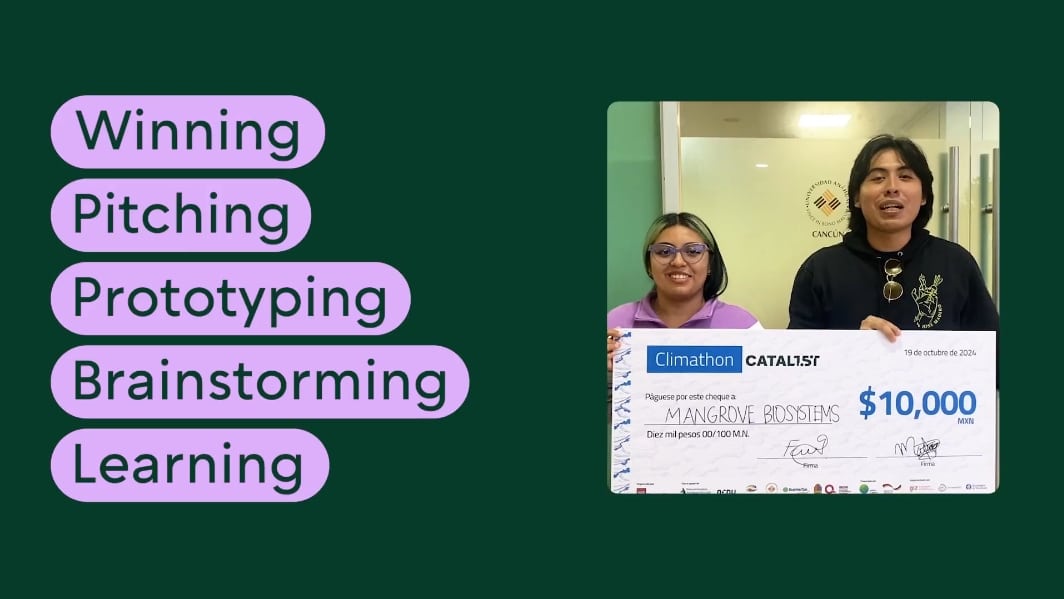
West Africa Winners
The West African finale highlighted a powerful focus on regenerative resources and the circular economy:
- First Place: Eco Diamba Ndaye (Senegal) Developed in Dakar, this project addresses the degradation and salinization of agricultural land. The team produces a biofertilizer made from local organic waste that restores soil fertility and provides an ecological alternative to chemical fertilizers. Watch the Pitch. | Connect on LinkedIn.
- Second Place (Joint): Cabian (Burkina Faso) Operating in Ouagadougou, this project tackles air pollution caused by burning paper waste. They produce biodegradable and accessible packaging made from recycled paper and cement bags, offering a sustainable alternative following national bans on single-use plastics. Watch the Pitch.
- Second Place (Joint): EcoBrique (Guinea) In Conakry, EcoBrique recycles plastic waste into low-carbon, waterproof ecological bricks. Each brick removes nearly 1kg of plastic from the streets, helping to prevent the clogged gutters that worsen local flooding. Watch the Pitch | Connect on Facebook.
- Third Place: Graine de Champion (Ivory Coast) This Abidjan-based project transforms rice waste into nutritious, affordable fish feed. It addresses food security by reducing the high reliance on imported feed for local fish farming. Connect on LinkedIn.
Latin America Winners
The Latin American finale showcased a sophisticated leap into biotechnology and smart urban mobility:
- First Place: Witlab (Mexico) Luis Alfonso Velázquez Martínez leads the way with biotechnology-based cleaning products. These bio-alternatives replace harsh chemicals, protecting regional water resources from industrial runoff. Connect on Instagram.
- Second Place: CityPooling (Argentina) Franco Sernaglia’s car-sharing app targets urban decarbonization. By optimizing commuter routes, it provides a scalable digital tool to lower the individual carbon footprint in bustling cities. Connect on Instagram.
- Third Place: Quitin-Out (Costa Rica) Michael Meléndez developed a biological vaccine to protect coffee crops. This innovation provides a natural shield for farmers, ensuring resilience against climate-induced pests without toxic pesticides. Connect on Instagram.
A Mindset Shift
“You have to go big or go home,” one participant remarked. And that is perhaps the greatest legacy of the Catalist initiative and Climathon.
By the end of 2025, the stats are formidable: 60 Climathons, 27 cities, 2,570 participants, and over 550 ideas. But the true success lies in the ecosystem that remains. Governments are now listening; banks are looking at these youth-led projects as viable investments; and most importantly, a generation has been made “responsible” for their own future.
If you are inspired by the potential of local innovation and want to learn more about our methodology, explore partnership opportunities, or find out how to get involved in future cycles, we want to hear from you.
To discuss the growing ecosystem in Latin America, reach out to Fabio Diaz Caballero.
For inquiries regarding the impact and future of our work in West Africa, contact Annabel Vanhoven.