
Seaweed, fisheries and coastal eco-tourism: how Zanzibar’s innovators are rethinking the blue economy
Most people know Zanzibar, Tanzania for its white sand beaches, turquoise waters and the kind of coastline that makes you want to stay longer than planned. But step away from the resorts and walk along the shore at low tide, and a different picture emerges.
Fisheries, aquaculture and seaweed farming provide livelihoods for thousands across the island, while tourism depends on a healthy marine environment. Yet the climate and oceans are changing fast. Seaweed farmers are losing 40 to 60 per cent of their annual income as rising sea temperatures trigger ice-ice disease (a stress-induced deterioration of seaweed crops caused by rising water temperatures) across shallow farms. Fishers spend more on fuel reaching new fishing zones as fish migrate to cooler waters. Coral bleaching is quietly impacting the reef systems that underpin the island’s tourism economy.
When Climate KIC, together with partners Coastal Biotech and Bahari Network, opened applications for the first-ever Blue Economy Climathon in Zanzibar, an event designed to develop locally-rooted solutions to protect the island’s coastal communities and marine environment, 300 people applied.
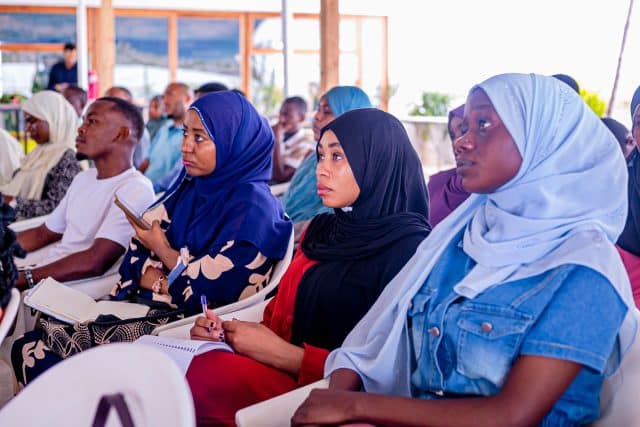
Participants take notes during the Blue Economy Climathon challenge sessions in Zanzibar, Tanzania © Climate KIC, 2026
What three days can produce
Fifty participants, including marine scientists, fishers, seaweed farmers, tech innovators, students and community leaders, came together in Zanzibar from 28 to 30 April to work on three challenges: improving seaweed farming, building sustainable eco- tourism and innovating climate-smart fisheries.
The challenges came directly from organisations working with affected communities. Coastal Biotech with 25,000 seaweed farmers, Action for Ocean with fishing cooperatives and Wildlife Conservation Society linking marine conservation with sustainable tourism. Each challenge was designed to be grounded in real community needs, ensuring that teams were solving real problems.
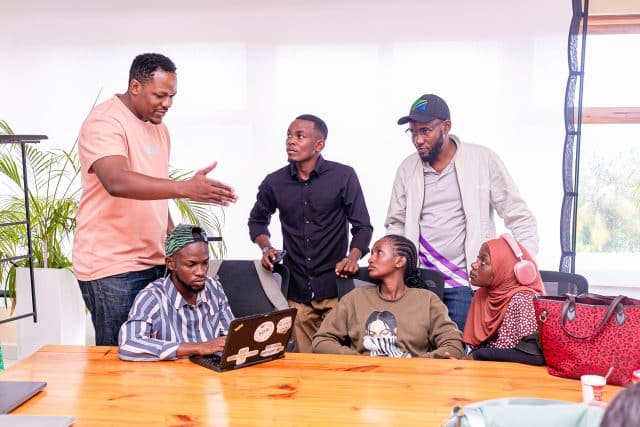
Trainer and mentor Amani Shayo from Spark Kwanza works with one of the teams during the Blue Economy Climathon in Zanzibar © Climate KIC, 2026
Over three days, eight teams worked through Human-Centred Design, the Climate Causality Framework and Lean Adaptation Canvas business modelling with the support of mentors, preparing their solutions to pitch to an expert jury. The teams that produced the strongest solutions were the ones who kept a user-centred mindset, who kept asking: will a fisher actually use this? Can a seaweed farmer afford it? Does this work in the rainy season?
Those questions came naturally to many participants because they represent the affected communities. As Kelvin Majula from Anza Entrepreneurs, who trained and mentored the teams, observed: “What struck me most was that the teams were not building ideas in isolation. Their solutions were directly rooted in the economic and environmental realities of coastal communities.“
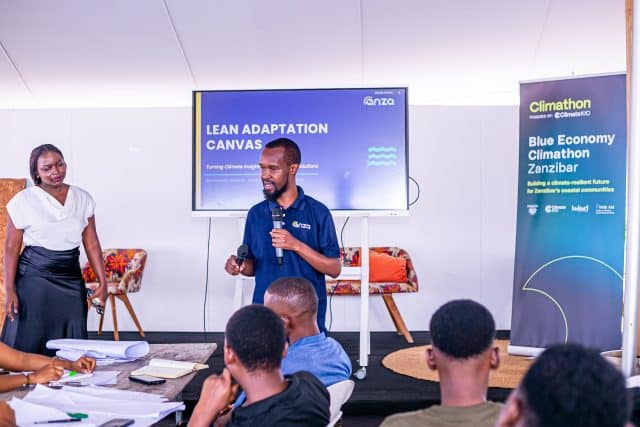
Kelvin Majula from Anza Entrepreneurs leads a session on Lean Adaptive Canvas business modelling during the Blue Economy Climathon in Zanzibar © Climate KIC, 2026
Tackling the most persistent problems
The winning team tackled one of the most persistent and impactful problems in Zanzibar’s fisheries: post-harvest loss. Small-scale fishers lose 30 to 50 per cent of their catch to spoilage because they have no way to preserve fish beyond the day of the catch. Their solution combines cold storage through the supply chain with a highly accessible, digital marketplace connecting fishers directly to buyers, addressing both the cold storage infrastructure gap and the income-loss gap in one model.
For Erick Elieza Mjwauzi, a young ocean leader and member of SOA Tanzania who was part of the winning team, the event opened his eyes to something bigger. “This provided me with an opportunity to strengthen my leadership skills in the ocean-climate nexus, while supporting the development of innovative solutions to build climate resilience for fisheries and marine resources.“
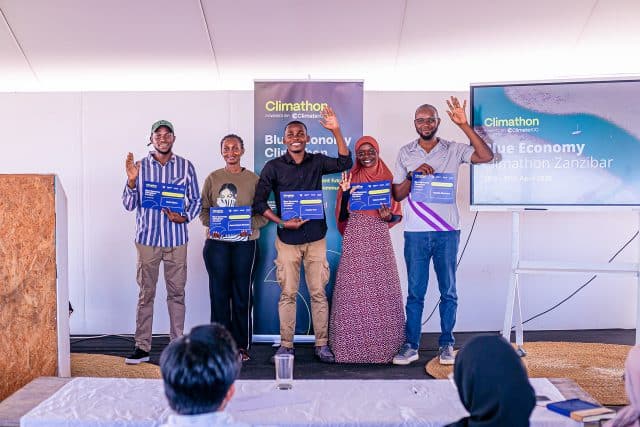
Erick Elieza Mjwauzi (left) and his winning team receive their certificates at the Blue Economy Climathon in Zanzibar © Climate KIC, 2026
Second place went to the team proposing a solar-powered drying system for seaweed farmers. Ground drying is unreliable when weather is unpredictable, leading to contamination and income loss. The solar dryer works regardless of rain, improves product quality and reduces climate vulnerability, particularly for the women farmers who make up the majority of Zanzibar’s seaweed sector.
For team member Mansab Seif Nassor, the experience went beyond the solution. “The Blue Economy Climathon helped me gain knowledge and practical experience about how climate change affects blue economy activities in Zanzibar. One of the biggest achievements for me was building confidence in public pitching. Before the Climathon, I was always nervous speaking in front of people. During the competition, I learned how to present ideas with confidence.”
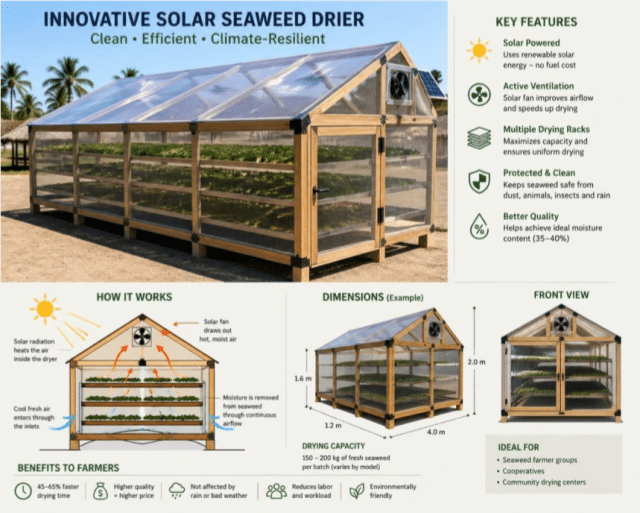
AI generated concept image of the solar-powered seaweed drying system proposed by the second-place team at the Blue Economy Climathon in Zanzibar © Climate KIC, 2026
What changed as a result
The top three teams will receive mentorship support from local experts and the winning team received €500 in seed funding. The second-place team has already identified five seaweed companies in Pemba as potential pilot partners for their solar dryer and has begun drafting a grant proposal to fund the first prototype. The ideas are already moving.
This is what the Climathon is designed to do. Not to produce finished businesses, but to create the conditions for sharper thinking, new connections and a framework for tackling a lived problem with a solution worth building. A Climate KIC initiative, the Climathon is the entry point of a business support process that connects teams with promising business ideas to the ClimateLaunchpad and the Adaptation and Resilience ClimAccelerator in Tanzania to help further scale those nascent ideas into healthy small businesses.
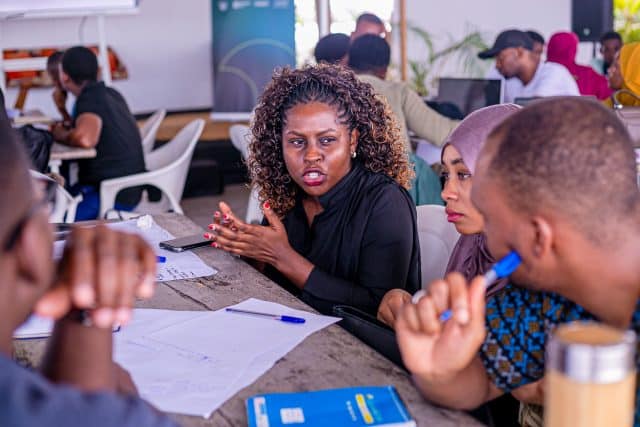
Divan Joseph, ocean conservasionist and blue economy advocate from Tanzania, brings lived ocean experience to the room at the Blue Economy Climathon in Zanzibar © Climate KIC, 2026
Why this matters
Trainer and mentor Amani Shayo from Spark Kwanza observed something that captures what made this event work: “One of the things that stood out most was how the teams reimagined what is possible using what already exists within their communities. Sometimes innovation is not loud or overly complex. It is deeply practical, rooted in lived experience, and inspired by everyday realities.“
“What we saw during these three days was both invention and the activation of a very strong ocean ecosystem,” says Inés Mas de la Peña, Programme Manager at Climate KIC. “Marine scientists met tourism operators, seaweed farmers met engineers, fishers met innovators working on digital platforms. The Blue Economy Climathon created the space for conversations, and now our role is to keep making those connections happen.“
This was the first Climathon in Zanzibar. It will not be the last.
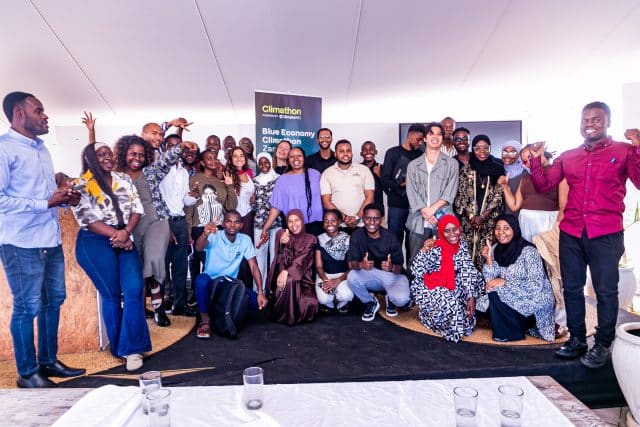
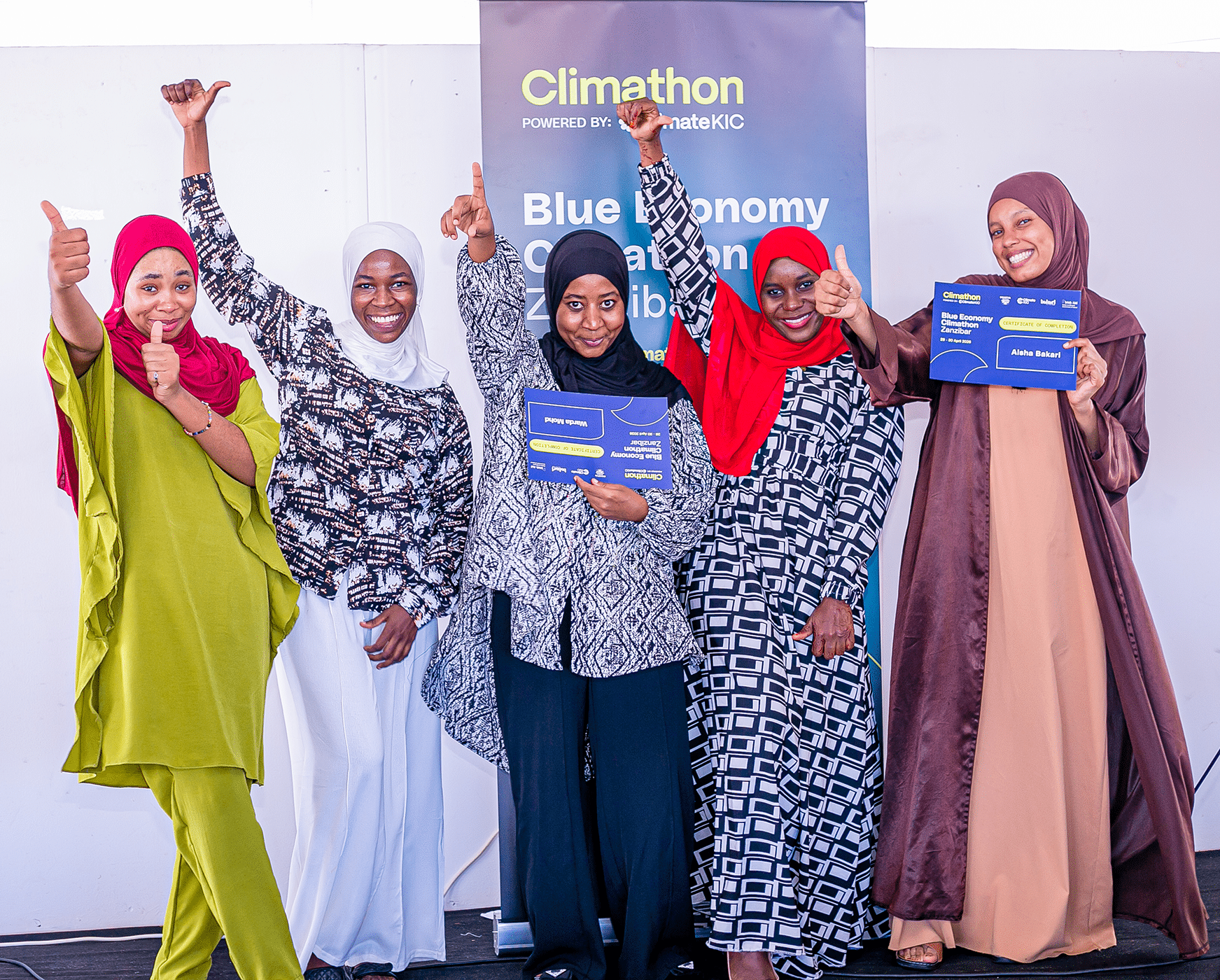
Group photo Blue Economy Climathon Zanzibar © Climate KIC, 2026
—————-
The Blue Economy Climathon was organised by Climate KIC in partnership with Coastal Biotech and Bahari Network and with support from Action for Ocean, Anza Entrepreneurs, MTI Investment, Spark Kwanza, Wildlife Conservation Society and Zanzibar Startup Association. Funded by Irish Aid. It is part of the Adaptation Innovation Cluster, a Climate KIC initiative working to build climate resilience through locally-led innovation in Tanzania.