
From planning to action: how local communities are investing in climate resilience to preserve their way of life
Across Europe, climate extremes are now a constant worry for local governance. Floods, heatwaves, droughts and wildfires are placing growing pressure on infrastructure, ecosystems and public services. The good news is that adaptation strategies are becoming more widespread. Just this month, London unveiled its first heat plan, developed through its participation in the Pathways2Resilience programme coordinated by Climate KIC.
The question now is how to move these plans off paper and into our territories. This year’s European Urban Resilience Forum, hosted in European Green Capital 2026 Guimarães by ICLEI Europe and the European Environment Agency, brought together hundreds of local leaders and climate experts to share what resilience looks like in their regions. From health and housing to nature-based solutions and community participation, discussions pointed to a common challenge: translating plans into action that people can see and experience in their everyday lives.
Turning climate plans into action
In Athens, climate action is increasingly being connected to visible improvements in quality of life. The city has planted more than 50,000 trees and is monitoring air quality through sensors placed in streets and schools, linking environmental action with public health and wellbeing. For Emmy Papazoglou, Director for Strategic Planning, Resilience and Innovation at the City of Athens, the priority is ensuring that plans translate into concrete benefits that residents can experience for themselves.
Health emerged as a particularly powerful entry point for adaptation efforts. Carlos Ribeiro, Executive Director of the Landscape Laboratory in Guimarães, argued that health is one of the clearest indicators of whether policies are working. Air quality, biodiversity and mobility are often addressed through separate policy frameworks, yet their impacts are ultimately measured through people’s wellbeing. Public investment in green spaces, he suggested, should be understood as an investment in preventative healthcare, where health begins long before people reach a hospital.
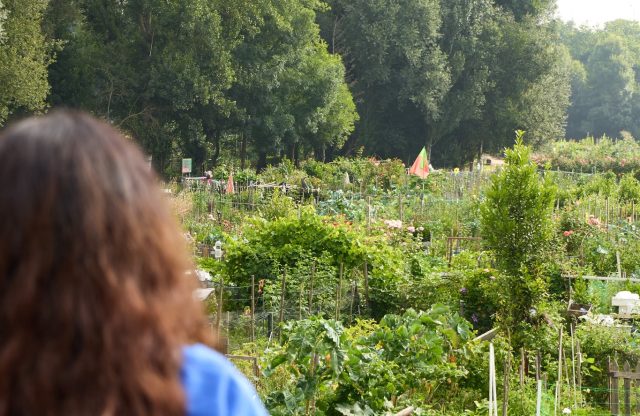
EURESFO participants visiting urban greening projects in Guimaraes. Credits: ICLEI Europe.
Housing is another domain where cities can take the lead. Mar Jimenez, Commissioner for European Affairs at the Barcelona City Council, pointed to the city’s efforts to regulate short-term rentals, a policy that has brought 10,000 housing units back onto the market, the equivalent of roughly ten years of public housing construction.
The discussion offered an important success factor for policymakers: resilience becomes easier to understand and support when it is linked to community outcomes that matter to people. Cleaner air, cooler neighbourhoods, adequate housing and better health can make adaptation visible in ways that technical plans alone rarely do.
Resilience under war and occupation
While all these actions can help build trust in local authorities, they also imply a responsibility to deliver. When a city has to contend with war and displacement, however, it is not easy to uphold a long-term resilience agenda in the face of severe constraints.
In Vinnytsia, Ukraine, internally displaced people now make up around one tenth of the city’s population. The rapid increase has placed additional pressure on housing, infrastructure and local services, while exposing challenges around governance and public trust. At the same time, as explained by Urban Innovation Manager Daria Kaliuzhna, strong civil society networks are helping communities organise, support vulnerable groups and maintain social cohesion under difficult circumstances.
For Jack Saadeh, Mayor of Ramallah in the Occupied Palestinian Territory, resilience cannot be separated from the realities of living under occupation. While climate resilience remains a priority, he explained that parts of Ramallah’s resources are controlled by illegal Israeli settlements surrounding the city, limiting its ability to manage land and water, and to plan for the future.
In this context, resilience begins with providing essential services, from water and sanitation to roads and waste collection, but extends well beyond infrastructure. The municipality also invests in cultural activities and programmes for children, who, as Saadeh noted, are often deprived of the space and opportunities they deserve. Resilience, in his view, is about helping communities remain connected, rooted and hopeful despite the dire circumstances.
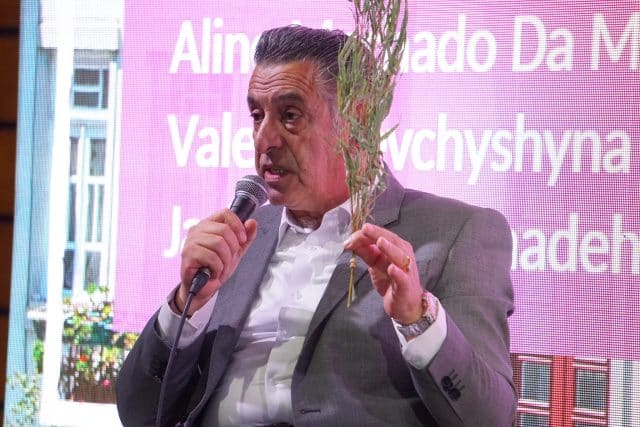
Mayor of Ramallah Jack Saadeh holding up a branch of bamboo – a recurring metaphor during EURESFO – to symbolise the resilience of Palestinian people. Credits: ICLEI Europe.
From reacting and rebuilding to preserving our shared landscape
Investing in climate resilience can also help local governments counter the cost of inaction. Annual climate-related losses in Europe already reach around €45 billion. In 2023, floods caused damages equivalent to 16% of Slovenia’s GDP. The disaster prompted tighter restrictions on building in flood-prone areas. While those measures were necessary, they arrived after the damage had already been done.
For Miljenko Sedlar, Head of Climate at the North West Croatia Regional Energy and Climate Agency, this is evidence that nature-based solutions must become a building block of planning and development, integrated into spatial planning, risk management and investment decisions from the outset: “We need to be proactive to preserve what we have”.
Solutions inspired by nature offer a way to do that. Newly constructed river basins in Guimarães can now retain up to 2 million cubic metres of water, and have helped the city prevent 53 floods last year alone.
This, however, could be challenging across borders. One way to overcome this barrier is through the concept of bio-regions. The Association of Danube River Municipalities has used a shared ‘Danube identity’ to foster collaboration across municipalities and communities in Bulgaria, Romania and Moldova.
For Manager Boryana Stancheva, this common connection to a landscape helps communities work together beyond administrative boundaries. Climate adaptation interventions become part of a broader vision about the future of places people live in and care about.
The shift from planning to action is echoed by Sedlar, reflecting on the importance of pilot projects to make climate resilience tangible: “Pilots make a difference because they show that it can be done, and they help define what can be done better or differently. They create a new way of thinking.”
Climate KIC works with cities, regions and partners across Europe to help turn climate ambition into implementation. Through systems innovation, adaptation pathways, nature-based solutions and climate finance approaches, we support a network of over 200 cities and regions in building and implementing tailored climate resilience journeys, from strategy to action to evaluation. Interested in designing yours? Contact us via the form below.