The practice, the mundane, the invisible: The everyday worldbuilding of learning as systems
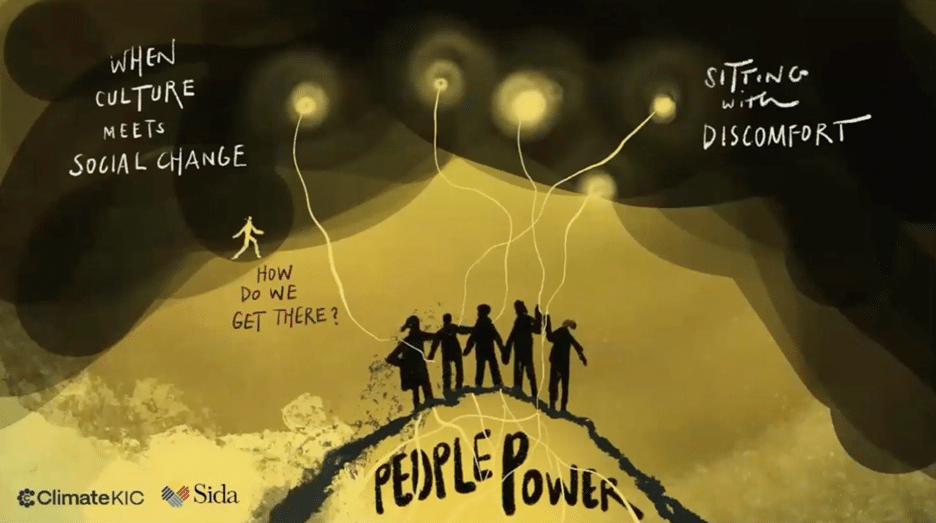
The work of systems change is often seen as built by glitzy multinational summits, strategy workshops, treaties and heavy, inspiring books and models. But once all lights go out, a quieter doing starts. It is the work of the intention landing on the ground. It is the hands working the social soil. The daily care and attention to learning and sense-making and adapting as we go.
SILP (Systems Innovation Learning Partnership) is an effort and a commitment held by Sida (Swedish International Development Cooperation Agency) and Climate KIC, exploring the conditions, capabilities, knowledge, operating environments and ecosystem of systems change. And whilst the intention is clear, the moment we move into implementation we arrive in the much talked about, but inevitably less well understood ‘Messy Middle’.
Impact reached by the less traveled part of the road
Commitment to systems change means a commitment to time, it means creating space, attention, structures, processes. It means you will not be doing the other thing you used to do. It requires a deeper presence, rather than pitching or selling. It means you will be training that ‘learning by doing’ muscle by yourself, and with others, by softening your gaze, paying attention, staying with stories, being open to new possibilities, without pushing outcomes to unfold before they are ready to.
And still, what our current organisational and systemic structures often offer can be seen as the wrong shape, but with the right intention. And by this we do not mean people paying lip service to systems innovation, but rather the frameworks we are working within serving the old agenda, supporting different perspectives, and seeking out and rewarding different stories as success. How many of us are tasked to learn and innovate on behalf of organisations? And once we do, how many organisations truly engage with what we learned, sit with the learning, digest it and operationalise accordingly?
We would like to share with you a couple of glimpses of how we engage with the interior conditions of systems, and how it shifts when we do the work of learning.
Creating space for practice. Practicing the practice. Talking about the practice
As within, so without. Since we put learning and innovation at the core of our work, the question is – how will we allow this to be present in our internal processes? Two ways that are particularly dear to our hearts: firstly, strategically choosing which monitoring and evaluation practices will best help us to embody the spirit of the work and secondly, training the muscle that helps us switch gears between operationalisation, strategising and reflective learning.
We have chosen Learning Inquiries as a framework to guide our curiosity, in place where more rigid KPIs might otherwise have been found. Learning Inquiries are questions representing the essence of the work and aim to not lead us to solutionise for answers (as Learning Questions might do), rather they aim to serve as a North Star, guiding and centering the exploration journey itself. And so, we defined one Learning Inquiry for each of the learning activity elements of our partnership, to our Experimentation Fund, or the particular interest of each partner. We periodically convened as a team to reflect on what we are learning in each Inquiry, and decide how this steers our action.
Monthly Heartbeats held by the implementation team brought a slower pace, and a more tender attention to what ideas, thoughts and feelings want to emerge, what is tough, what matters to our hearts. They provided spaces for our vulnerability, for thoughts we only knew the beginning of at the time, and for holding silent moments together. Tracked over time, they showed us the cracks in which progress can hide, when we were too focused on looking at the straight lines we planned to follow along. Looking back, we now see how early some ideas were bubbling underneath the surface, and what time it took for them to take shape. We treated these as rare gifts, that often remain unnoticed.
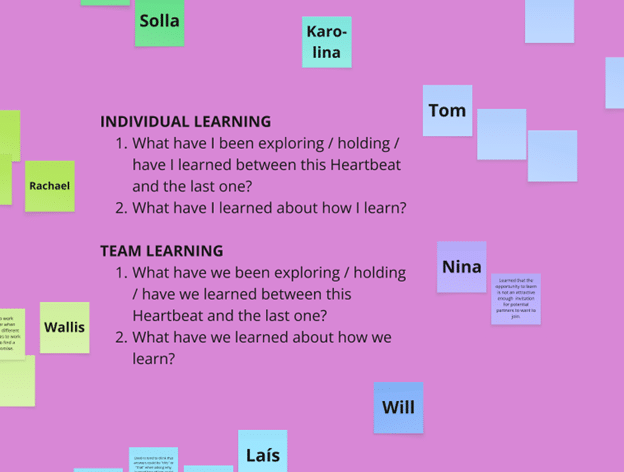
As our team’s constellation changed, we discontinued holding the Heartbeat moments. And I still miss this salon-like, almost philosophical space of relating to our work from a different place in me and a shifting of gears, to a dynamic that for some might still not belong to the work-place.
Doing the mundane as if the future were now
Regular funding typically supports a number of projects implementing their proposed solutions and presenting the results in a final report. But if what you are seeking is systemic learning, rather than pre-defined results, you need to do something different in the process as well. This is why our Experimentation Fund Cohort has been invited to monthly check-ins and why we hosted collective Sensemaking sessions, rather than internally evaluating mid-term reports.
Monthly check-ins, slow at the start, with uncertainty of who is in the room and what is expected or appropriate to share, have over time become sessions of story-telling, inspiration, collegial consultations and mutual encouragement. We saw them inspire and challenge planned actions and inform new standards. One group would collaborate with an external MEL professional to help them understand how they believe change happens. Another group picked it up and implemented it. One group shared how surprisingly challenging convening with grassroot stakeholders has been, in spite of shared purpose, and teams working with grass-roots organisers shared their experiences. The pathways of discovering where we can be of service for each other were never straight, but told us that if you walk the path, it will show itself to you.
When it came to mid-term reporting, we knew we did not want the funder team to be the ones who decided what the grantees learned and how satisfactory the progress was. What we did instead is we asked all projects for permissions, shared all reports with everyone, and gathered together over two days for collective Sensemaking, allowing the meaning between us to emerge through conversation and engaging with each other’s stories.
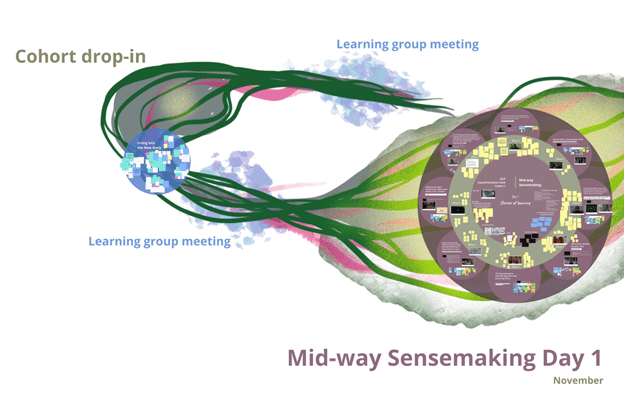
Even though we facilitated our learnings together and the process felt truly mutual, it still felt like the ownership of the learnings was staying within the funding organisation, rather than somewhere shared between all of us. The question of what might take, other than commitment over time, remains one we hold until we know the next step.
Making the invisible visible. For others. With others. Across time
For SILP, learning is at the heart of creating systems change, but our efforts to actually bring learning to the heart – on a truly systemic level – has often felt restrained through grant cycles, impact definitions, power differentials between actors, and the tension between certainty and discovery.
Seeing how our different approach to funding has been received with a sense of relief and awe by many of the grantees, we started wondering – what other actors are making their invisible steps towards more systemic funding? And how is their journey?
We created an opportunity, together with Climate Adaptation, Innovation and Learning, a UNIDO initiative, to convene over 20 global intermediary funders and Entrepreneurship Support Organisations with whom we felt our work might create greater ripples of impact and influence.
Coming together across a couple of weeks, sharing stories, we began to soften our attention until a deeper, shared understanding begun to emerge. We discovered that the feeling of being stuck between a rock and a hard place is a daily reality for many of us. One we actually cannot resolve, no matter how much effort we put into it. Sometimes the paradoxes, the tensions do not go away when you engage with them. Sometimes what you learn instead is that you will have to learn how to live with the tensions. And lean into them, so they guide you how to serve both: the fast successes and the deep shifts, the compliance and the innovation, the nuance and the easily digestible communication.
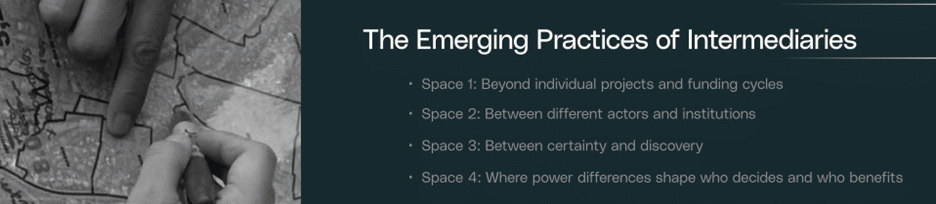
The line that still seems difficult to draw is the one that enables learnings to find their way back to our organisations, and actually change how we operate.
This work might need a longer time than our funding cycles currently allow, we might need to learn how to hold it between projects, between teams. As Climate KIC’s Head of Philanthropy; Melody Song, recently stated in our convening around worldbuilding future funding architecture: “We are not in a system, but between the systems”. And as Bayo Akomolafe says: “Everything begins in the middle”. If we are neither at the end, nor at the beginning, but in a middle, how do we write this story? How do we support systems shift attention away from big gestures, to the smaller ones, happening across time, held by many? Gestures, that amount to a non-linear shift in the quality towards a just, climate-resilient, beautiful and sustainable future?
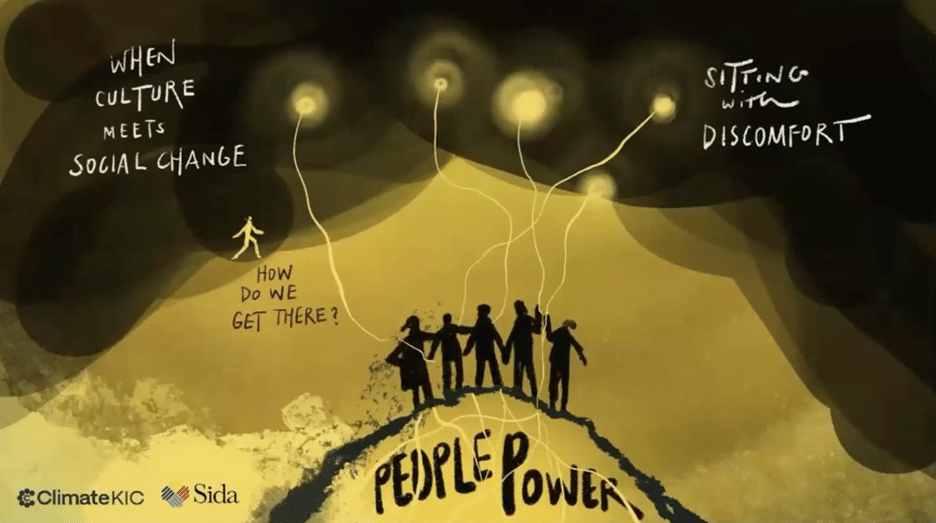
Image courtesy of Jayce Pei Yu Lee – 🐋 Jayce Pei Yu Lee | LinkedIn