
The promise Europe broke, and how to remake it
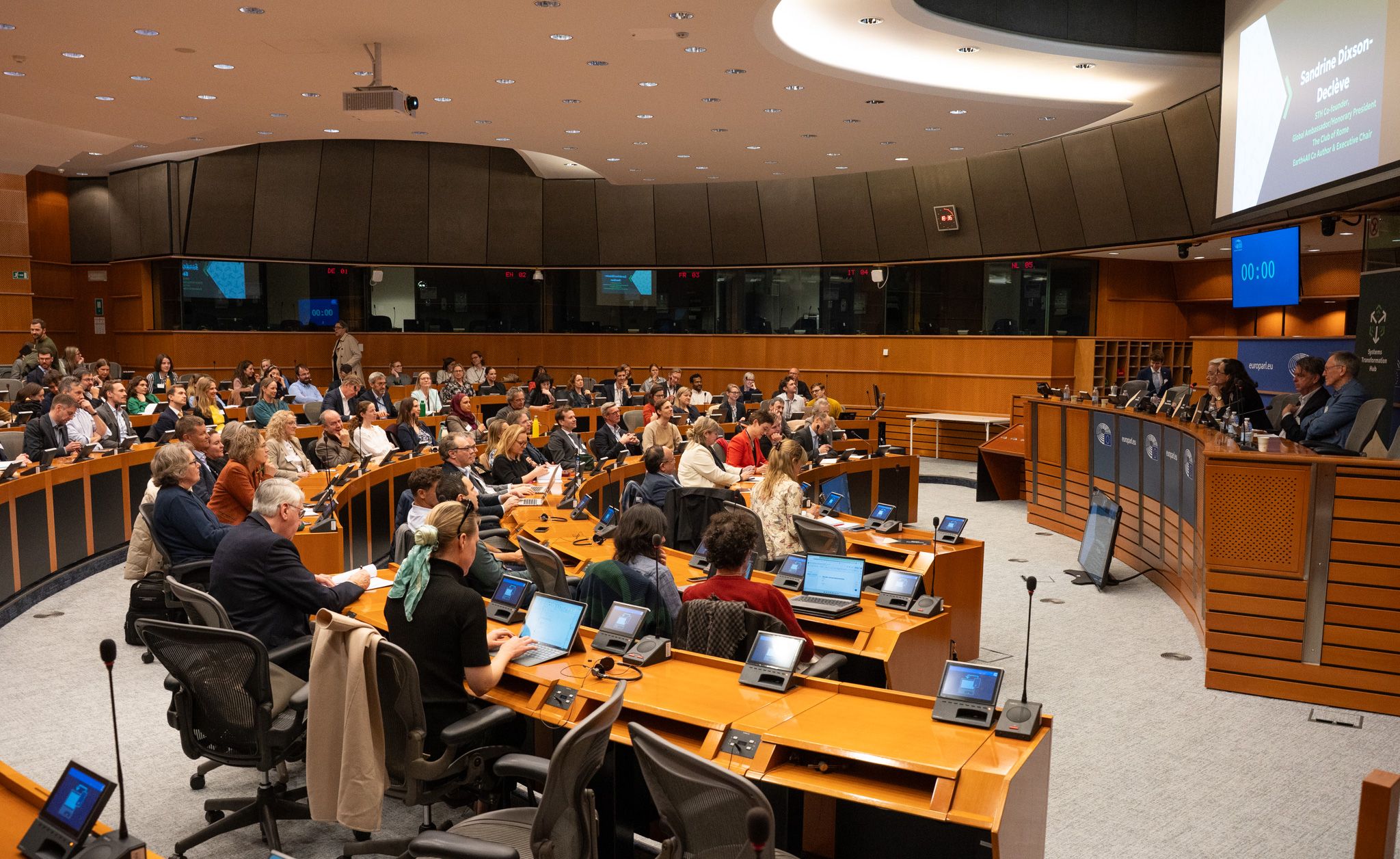
There is a particular kind of clarity that comes from crisis. When the assumptions and scaffolding holding a system together begin to buckle, the things that were always true but easy to ignore become impossible to avoid. Europe is living through that moment. Last week, in the European Parliament, a community gathered to name the fractures, reaffirm that transformation is still possible, and showcase concrete solutions. The occasion was the Systems Transformation Hub’s anniversary. But more than celebration, it was a reckoning, a renewal of purpose and an invitation for that community to work together on solutions that exist but need recognition and scaling.
A world that has changed beneath our feet
The assumptions that shaped Europe’s post-war growth model have not merely been challenged. They rested on a set of assumptions: that short-term profit maximisation, paired with redistribution through taxes and welfare, was a reasonable proxy for collective welfare; that democracies, once established, were self-sustaining; that the economy could grow indefinitely within a finite planet. For a time, those assumptions held well enough.
But the recent deregulation and race to the bottom on standards are not delivering shared prosperity. Today, the model we produced has hollowed out the social fabric, the public trust, and the ecological base that it depended on. Over half of the world’s total GPD, $44 trillion of economic value generation, is potentially at risk as a result of the dependence of business on nature and its services.
Diluting the rules further will not make European companies more competitive. It makes European workers, consumers, and communities worse off. In Europe, already one in ten workers lives at risk of poverty, and over 1.2 million people are unhoused. Europe is also the fastest-warming continent which means that the people already left behind by the current model will be the first to bear the costs of its ecological consequences too. The injustice adds up.
As one voice in Brussels put it: we don’t need a better version of this system. We need a different one. One that measures not just what we produce, but whether people and planet are actually thriving.
The solutions are not distant or exotic and we don’t need to look elsewhere for a model. Europe already knows what direction it wants to move in. What it needs is the will to complete the journey: not just one market, but one community rebuilt on a social contract that reaches across borders and generations, with an economy that serves people, not the other way around. Justice not as an afterthought, but as the architecture.
What this means in practice
Europe needs science-based material targets, sustainable land use frameworks, a fifth freedom, reliable data that enables genuine accountability, city-industry lead markets, and a serious reckoning with natural capital. It needs to stop treating growth as the default measure of progress and start measuring what people actually need to flourish. It needs resilience — not as a buzzword, but as a genuine capacity to absorb shocks, learn, and reorganise.
And it also needs to redefine its terms.
Competitiveness, for a start: the companies that will lead in the medium and long term are those that have already internalised climate and environmental costs. The ones that refuse to get on board are storing up risk.
Security, too: in a world of resource shocks and geopolitical fracture, security means water and food as much as it means defence.
And strategic autonomy cannot mean much for a continent that imports the fossil fuels and raw materials it runs on. The route to genuine autonomy runs through clean energy and circularity — turning what Europe already has into the resources it needs, rather than remaining dependent on others for both.
And then there is the dimension that is hardest to quantify but perhaps most urgent: the emotional one. Europe needs optimism. Here, we are not talking about shallow optimism of managed decline dressed in hopeful language. What we mean is that Europe needs the confidence that comes from honest diagnosis and genuine commitment. It needs boldness. It needs hope. And hope, in this context, is not passive. It is a practice. We have our own model based on our values and on our unique situation – lets practice it.
The interface that Europe needs: Systems Transformation Hub
This is where the Systems Transformation Hub becomes something more than a convening body. It becomes, as its name implies, an interface and a catalyst.
There is a concept in systems theory called an acupuncture point: a place in a complex system where a small intervention can unlock large-scale change — not by force, but by releasing what was blocked. Transformation rarely happens through a single large push. It happens when the right connections are made between people, institutions, and ideas that were not previously in dialogue: when a city government discovers it is working on the same problem as an industry consortium across the continent, when a scientist and a community organiser realise they share not just a problem but a theory of change.
This is what Climate KIC, Club of Rome, Metabolic, Systemiq Ltd. and World Resources Institute Europe do on the EU level through the Systems Transformation Hub. Interfaces do not not replace existing institutions or pretend to have all the answers, but they catalyse the conditions for answers to emerge from the collision of perspectives that would otherwise never meet.
In a world where institutional silos, political polarisation, and short-term pressures prevent the systemic thinking the moment demands, bypassing those blockages is itself a radical act.
The community that makes change possible
The community that gathered in Brussels in March 2026 were there because they believe that things can be different. They believe that the interdependencies of our time can be leveraged and that the millions already protesting, organising, and building alternatives on streets across Europe and the world are not a symptom of dysfunction but the beginning of something.
Individual action matters. Not because it substitutes for structural change, but because it creates the connections through which structural change becomes possible. The task of the STH is to strengthen that community and to make it more coherent, more capable, and more visible to the institutions that need to hear it.
The focus now for Europe needs to be on interventions that build resilience, reduce emissions, restore natural capital, and strengthen social cohesion simultaneously. What is needed now is the imagination to see them, the courage to pursue them, and the trust to pursue them together.
Follow the Systems Transformation Hub on LinkedIn to stay up to date.