Inside Europe’s shift to climate-neutral farming
Climate change is reshaping the future of farming in Europe. Rising temperatures, longer droughts and erratic rainfall are testing even the most resilient food systems. At the same time, farmers across the continent are proving that transformation is both necessary and already underway.
Since 2022, Climate KIC has played a key role in ClieNFarms, a project funded under the EU’s Farm to Fork Strategy, which forms part of the European Green Deal and aims to make Europe’s food systems fair, healthy, and environmentally sustainable. Bringing together partners from across Europe and beyond – including one in New Zealand – ClieNFarms tests and scales practical solutions for climate-neutral and climate-resilient agriculture in a wide range of farming systems, from Mediterranean arable crops to Oceanic dairy and beef farms.
As it prepares for its final conference in Brussels this November, the project is sharing what three years of fieldwork have revealed: that systemic, farm-level innovation can drive meaningful change across the entire food system.
A network for transformation
The project’s demonstration approach, known as the Innovative Systemic Solution Space (I3S), brings together demonstration farms, advisors, researchers, financial actors and supply-chain partners to co-develop and test new approaches in real conditions. Each I3S operates as a ‘living lab’, where farmers and local stakeholders experiment with solutions tailored to their specific context. The aim is simple but ambitious: to connect technical, organisational and financial innovation so that climate-smart farming becomes economically viable and widely replicable.
Cutting emissions in practice
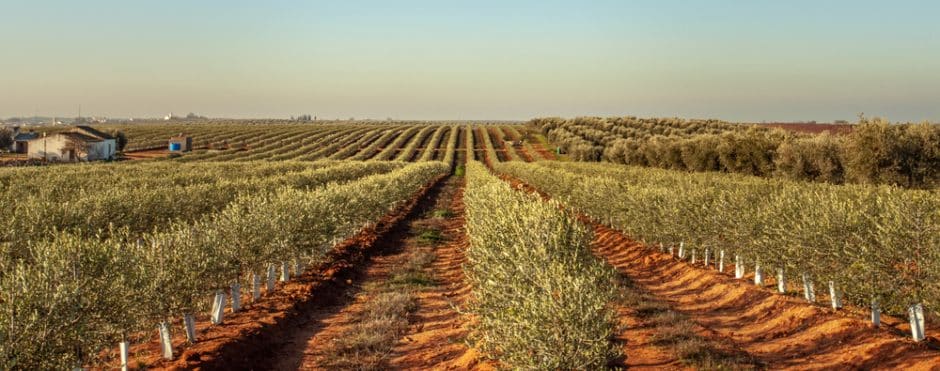
Across twenty demonstration sites, farmers have been testing a range of practices that together point the way to lower-carbon, more resilient food systems. In Portugal’s Alentejo region, trials at the Outeiro demonstration farm are sowing biodiverse strips of legumes and grasses between olive-tree rows. The aim is to revive tired soils that have been compacted by machinery and to bring back pollinators that keep orchards productive. Early results point to richer vegetation, better rainwater infiltration and fewer erosion losses – gains that make groves more resilient to both drought and heavy rain.
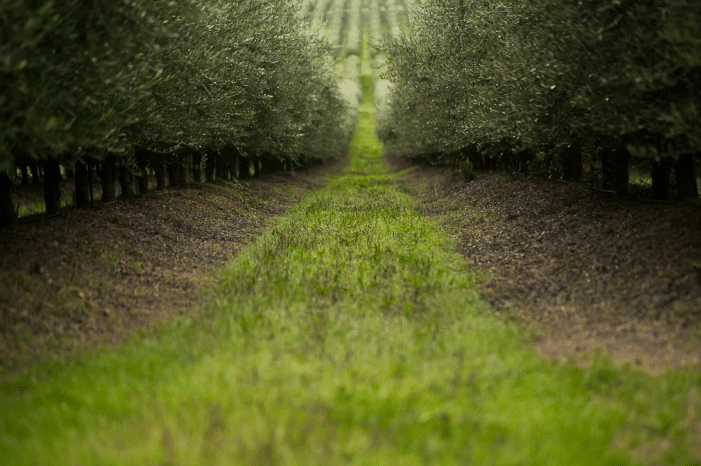
Permanent biodiverse meadow in the inter-row of an olive grove in Portugal’s Alentejo region.
Further north, in south-west France’s Lauragais plain, farmers are experimenting with almost permanent soil cover between cash crops. Rotations of summer grasses and winter legumes are expected to cut fertiliser use and build organic matter, locking carbon in the ground instead of the air. The approach also avoids herbicides such as glyphosate by destroying cover crops mechanically, which shows that low-input farming can still be efficient.
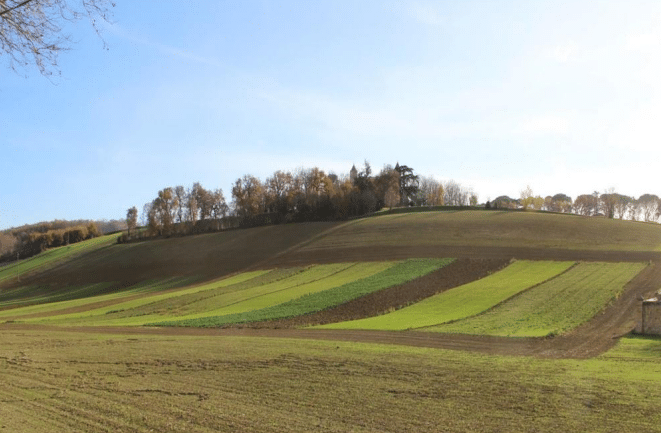
Cover crops on the Lauragais plain in south-west France.
And in the United Kingdom, researchers at the GWCT Allerton Project are testing biochar made from farm residues. When added to soil, this carbon-rich material could store atmospheric carbon for centuries while improving water retention and fertility – turning hedge cuttings and crop waste into a long-term climate asset.
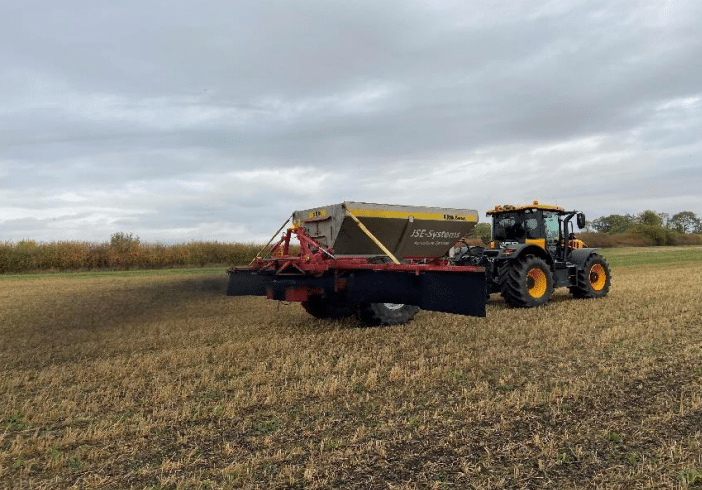
Agricultural operations for the application of biochar on British fields.
Each practice is modest on its own, but together they provide a blueprint for farms that emit less, store more carbon and remain productive in the face of climate change.
Circularity and resource efficiency
The project has also explored circular uses of waste streams and renewable energy. In the United Kingdom, the University of Leeds is testing the N₂ slurry processor, which uses electricity to turn animal manure into a more stable, nutrient-rich fertiliser called Nitrogen Enriched Organic (NEO). The process traps nitrogen that would otherwise escape as ammonia or methane, cutting odours and greenhouse-gas emissions while reducing the need for synthetic fertiliser. Its full climate benefit depends on using renewable power to run the system.
While in Romania, researchers at the National Institute for Animal Biology and Nutrition (IBNA) are exploring how local oilseed by-products, known as oilseed cakes, can be used as a natural feed supplement for small ruminants. These high-lipid residues could cut methane emissions from digestion by up to 15 per cent while improving milk quality. And because the material is locally sourced, it also supports circular farming and reduces reliance on imported feed.
These solutions contribute to climate neutrality by reducing imported inputs, closing nutrient loops and valuing by-products that would otherwise go to waste.
Scaling trust, as well as tools
ClieNFarms is not only about testing techniques. Its strength lies in showing how innovations can spread. Through its Scaling Toolbox, developed by Climate KIC alongside project partners, a framework has been designed to help farmers, investors, advisors and policymakers turn local success into wider transformation.
The toolbox brings together methods for analysing barriers, building value chains and developing roadmaps for change – all grounded in three essentials: value, risk and trust. For farmers, it means instilling the confidence that new practices will pay off. For financial institutions, it means credible pathways to invest in transition. And for regional authorities, it means policy instruments that enable collaboration rather than fragmentation.
Alongside the toolbox sits the Solutions Catalogue, an open repository of farm-tested measures from across Europe, and new business models co-developed with companies such as Nestlé and Friesland Campina. These models explore how the food industry can reward climate-smart practices within supply chains – linking farm-level mitigation to market incentives.
A holistic vision of climate neutrality
The project’s first Policy Brief argues that climate neutrality in agriculture cannot be defined solely by greenhouse-gas budgets. True neutrality, it notes, depends equally on soil health, biodiversity, water and nutrient cycles, and the biophysical effects of land use – from albedo to evapotranspiration.
This holistic framing places resilience at the centre of mitigation. Strengthening nutrient cycles, soil structure, water retention and biodiversity enhances the system’s ability to recover from shocks while reducing emissions over time. The brief calls for policies that reward such integrated performance rather than single-metric reductions.
Learning from business and behaviour
ClieNFarms’ work on business models complements this systems view. Partners examined how major dairy and food companies could integrate carbon-efficient practices into their sourcing and incentive schemes. The studies found that economic instruments, especially incentives and cooperative governance structures, are critical for scaling change – aligning climate ambition with farm profitability.
At the same time, interviews across the I3S network revealed that behavioural factors matter as much as finance. Building trust between farmers, advisors and institutions emerged as the main lever for transition. Training, peer learning and transparent data were identified as key enablers. These findings have been woven into the Scaling Toolbox – ensuring that social and organisational dimensions are treated with the same rigour as technical ones.
Towards Brussels
The upcoming ClieNFarms Final Conference on 20 November 2025 in Brussels will bring together the project’s partners and a wider community of practitioners. The event will showcase key outcomes from the project, as well as hosting panel discussions on topics such as smarter agriculture for climate neutrality, scaling climate in farming systems, advancing knowledge for climate smart farming and challenges in modelling GHG emissions on European farms.
For farmers, advisors and policymakers alike, the event will be a chance to explore how tested innovations, digital tools and cooperative models can accelerate the transition to climate-neutral farming systems.
A foundation for the future
As ClieNFarms concludes, its legacy is a set of tested solutions and an approach that connects the dots between science, practice and policy. The project has demonstrated that climate neutrality in farming is not a single innovation but a network of interdependent actions – each reinforcing the other.
By combining practical experimentation with systemic analysis, ClieNFarms has laid the groundwork for a European farming sector that is both climate-smart and economically robust. The next challenge is scale: turning dozens of demonstration farms into thousands. That process begins with sharing what works – and that is what Brussels will be about.
Register for the ClieNFarms Final Conference here and learn more about the project at clienfarms.eu
Join the movement for resilient, regenerative food systems
We’re building a movement for resilient, regenerative food systems by bridging the gap between policy, innovation and practice. From supporting farmers in adopting climate-smart agriculture and renewable-energy solutions, to facilitating dialogue between policymakers and practitioners at the European Carbon Farming Summit, Climate KIC is demonstrating that sustainable agriculture is practical, scalable and economically viable.
Whether you’re a farmer pioneering new practices, a researcher developing innovations, an organisation committed to climate action, or a supporter interested in transforming food systems around the world, we want to hear from you. Visit our #FoodFutures hub to learn how you can partner with us – and join our dedicated Farmers Network to shape the future of agriculture.