
Germany joins growing Europe-wide movement to unite industry and cities on climate action
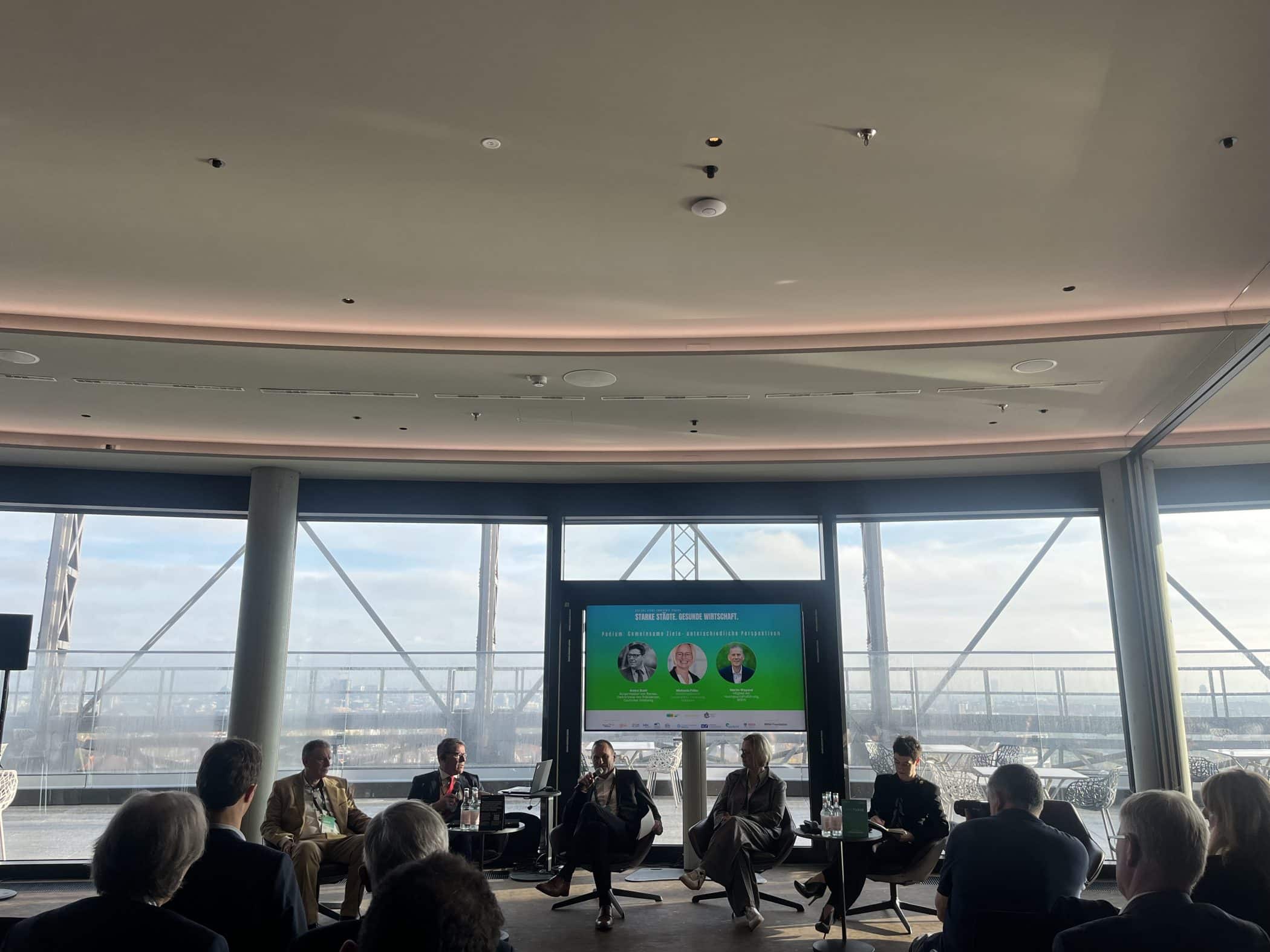
Berlin’s city-industry dialogue marks latest milestone in Climate KIC’s mission to connect urban and business leaders across Europe
Climate KIC, together with ICLEI Europe and the World Business Council for Sustainable Development (WBCSD), has launched a two-year dialogue process in Germany, bringing municipalities and industry together under the banner “Strong Cities. Healthy Economy.” The kick-off event in Berlin on October 23rd drew around 80 representatives from industry, cities, federal and state governments—demonstrating the urgent appetite for collaboration on climate neutrality and economic competitiveness.
This German initiative builds on Climate KIC’s successful city-industry dialogues already underway in Spain, Poland, and Finland, creating a growing European network where cities and businesses can discover their shared needs and build solutions together.
Connecting demand and supply at scale
The dialogue process addresses a critical gap: while climate change is already causing costly damage to local infrastructure and supply chains, the investments needed for resilience, climate action, and innovation far exceed what most municipalities and companies can finance alone. Yet cities and businesses share similar needs for clear policy direction, agile governance, patient investment across multiple asset classes, and the opportunity to combine multiple puzzle pieces into effective ecosystems.
“Climate neutrality and competitiveness are not mutually exclusive. On the contrary, they reinforce each other,” said Kirsten Dunlop, CEO of Climate KIC. “Sustainability is becoming the leading driver of global competitiveness, local prosperity and economic, political and social stability. This transformation opens up enormous opportunities for German companies to enter new markets and for cities to increase their quality of life and attractiveness.“
From ambition to action
The Berlin kick-off focused on core sectors including buildings and construction, transport and mobility, and energy, heating and cooling. Critically, discussions also explored the practical levers needed to move from aspiration to implementation: financing mechanisms, procurement strategies, standardisation, and planning procedures.
An initial impulse paper released at the event captures the shared insight among participants: climate protection represents a necessary investment in jobs, quality of life, and economic strength. As Wolfgang Teubner, Director of ICLEI Europe, noted: “In an urban world, cities design the infrastructure that people and businesses need. Their investments in infrastructure are a key driver of transformation, growth and competitiveness. It is therefore essential to secure and strengthen the investment power of cities and public companies.“
Creating space for trust and innovation
The strong turnout in Berlin signals that German industry and municipalities recognise this is the right moment for structured collaboration. “The great interest on the part of industry clearly shows how important it is to have this dialogue now,” said Sabine Kuschel, VP Leadership & Challenges at the BMW Foundation Herbert Quandt, which supported the event. “We are creating a space in which trust can grow and sustainable solutions can be developed together—for an innovative economy and a sustainable society.“
Boris Brkovic, Senior Manager at WBCSD, added: “The transformation to climate neutrality will not be decided in distant future scenarios, but in the concrete projects that we are initiating together today. The city-industry dialogue shows that industry and cities want to work together and take responsibility. We hope to translate these approaches into concrete results in the coming months with as many representatives of industry and municipalities as possible.”
Looking ahead
As the EU sets ambitious climate targets while striving to strengthen domestic economic competitiveness, Germany’s cities and companies stand at the centre of delivering on both imperatives simultaneously. The two-year dialogue process aims to translate this shared commitment into concrete results, with new procurement models, innovative financing structures, and joint projects that demonstrate how climate action and economic vitality can advance hand in hand.
With dialogues now active in Germany, Spain, Poland, and Finland, Climate KIC, WBCSD and ICLEI are together building a European movement where scale and complexity become preconditions for sustainability rather than barriers and where cities and businesses can move from pilots to procurement and from aspiration to implementation.