
Why every business must buy into biodiversity
A new report from the Intergovernmental Platform on Biodiversity and Ecosystem Services (IPBES) finds that the growth of the global economy has been at the cost of immense biodiversity loss. But every business depends on biodiversity, and this loss now poses a critical and pervasive systemic risk to the economy, financial stability and human wellbeing.
The cost of growth
The IPBES report shows that while the global economy has grown from $1.18 trillion to over $130 trillion since 1820, natural capital has declined by 40 per cent per capita since 1992. Meanwhile, in 2023 alone, $7.3 trillion in public and private finance flowed toward activities directly harming nature, compared to just $220 billion directed toward biodiversity conservation and restoration.
“Biodiversity loss is not just a side effect of economic growth but a profound systemic risk to our economies, financial systems and societies,” says Pernille Modvig, Project – and Team Lead for the Resilient and Climate Neutral Regions cluster at Climate KIC. “It demands that we redesign value creation within planetary boundaries, rather than treating nature as an externality.”
Every business depends on biodiversity
One of the IPBES report’s most important contributions is its insistence on universality. “Every business depends on biodiversity, and every business impacts biodiversity,” the IPBES concludes. This holds true even for companies that don’t consider themselves connected to the natural world. From flood mitigation and clean water supply to tourism, food production, and cultural value, businesses rely on ecosystem services whether they recognise it or not.
Creating the conditions for change
The IPBES report offers over 100 concrete actions for businesses, governments, financial actors, and civil society, organised around five essential enabling conditions: policy, legal and regulatory frameworks; economic and financial systems; social values, norms and culture; technology and data; and capacity and knowledge.
Taken together, these points demonstrate that transformative action requires collaboration across governments, financial institutions, civil society, and innovative organisations working at the intersection of climate, business, and sustainability.
Translating global limits into local action
This is where organisations like Climate KIC play a critical role, bridging the gap between global frameworks and on-the-ground implementation.
“By applying methodologies like the Butterfly Model and Reduction Roadmap, Climate KIC is working with partners across Europe to translate global climate and biodiversity limits into concrete sectoral pathways,” says Modvig. These pathways couple CO2 reduction with ecosystem protection, land restoration and a shift from extractive construction and monoculture farming, moving towards regenerative materials and the conversion of up to 50 per cent of used land into biodiverse ecosystems.
Originally developed by the Ellen MacArthur Foundation, the Butterfly Model is a framework for circular economy thinking. Its well-known diagram illustrates how materials can flow continuously through two interconnected cycles. In the technical cycle, products and materials are kept in use through reuse, repair, remanufacture, and recycling. In the biological cycle, nutrients from biodegradable materials are returned to the earth to regenerate nature, closing the loop rather than extracting and discarding.
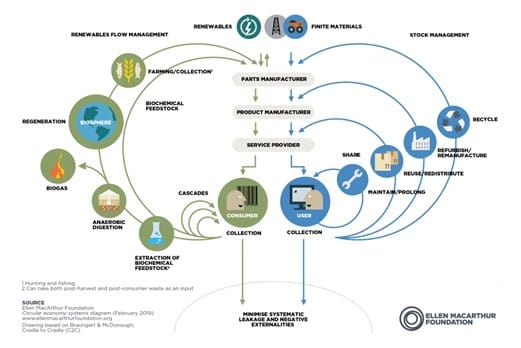
“We wove this concept into our framework for reconnecting forest-to-wood value chains with regards to long-term carbon storage in wood products. It ensures wood is kept in use as long as possible, through circular economy principles,” says George McLoughlin, Forestry and Bio-based Systems Expert at Climate KIC. By keeping wood circulating in the economy for longer, the approach maximises both carbon storage and resource efficiency, while reducing pressure on forests themselves.
A moment for redesign
The IPBES report shows that while financial risks are mounting, the tools for action — from regulatory frameworks to circular economy methodologies — already exist. But they need to be applied at scale.
For businesses, this means moving beyond sustainability reporting and toward genuine integration of biodiversity into strategy, investment decisions, and operations. For governments and financial institutions, it means redirecting the trillions currently flowing toward nature-destructive activities. And for organisations at the frontier of climate and systems innovation, it means continuing to develop and deploy the frameworks that make change possible and tangible.