
Climate adaptation solutions need to travel. But they cannot just be copied and pasted.
Across Europe, many places are grappling with different forms of climate stress, from too much water to too little, alongside rising heat and biodiversity loss. Faced with similar pressures, it can be tempting to assume the same solutions will work everywhere. But successful adaptation cannot simply be copied from one place to another. Through the ARCADIA project, Climate KIC is playing a key role in helping regions learn from each other while adapting those lessons to local realities.
In 2022, severe flooding hit communities around Karlovo in Bulgaria’s Plovdiv region, damaging villages and raising difficult questions about how to rebuild while reducing future risk. Four years later in April 2026, representatives from Plovdiv were meeting peers from Lower Austria and Skåne to discuss how Nature-based Solutions could form part of a longer-term response.
They explored floodplains and river corridors, but just as importantly, the less visible conditions that determine whether Nature-based Solutions succeed – from the way farmers and landowners are engaged to how institutions coordinate and planning systems respond. This was part of ARCADIA’s twinning process, a structured approach to helping European regions learn from one another.
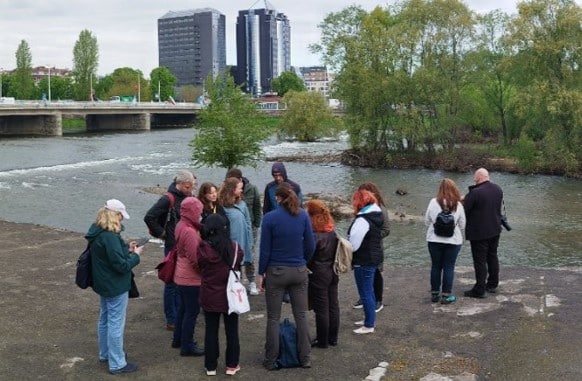
ARCADIA partners during a field visit to the River Maritsa in Plovdiv as part of the April 2026 twinning exchange.
From transferring solutions to learning together
Climate adaptation is often discussed in terms of scaling successful solutions. But what works in one place cannot automatically be replicated somewhere else. Technical design is only part of the equation. Governance, finance, planning systems, land ownership, institutional capacity and relationships between stakeholders can all determine whether an idea succeeds. ARCADIA, therefore, starts with a different question,’What can we learn from this experience – and what would need to change for it to work here’?
During the first phase of twinning, Plovdiv in Bulgaria, Centru in Romania and Podravje in Slovenia were paired with Model Regions elsewhere in Europe. Instead of just showcasing good practice, partners identified their own challenges and learning needs before exploring together what might be transferable.
Learning around real problems
The April 2026 study visit to Plovdiv shows what this looks like in practice. Lower Austrian partners shared experience of working with farmers and landowners on green infrastructure such as hedgerows and ecological buffers. During the visit, it became clear that technical solutions are unlikely to succeed without understanding the motivations and needs of the people expected to implement them.
Partners from Skåne brought experience of stakeholder mapping, public-private collaboration and creating neutral spaces where authorities, landowners and civil society can develop solutions together. These ideas were relevant to a practical challenge in Plovdiv, where responsibility for water management, biodiversity, spatial planning and environmental protection is spread across several institutions. The lesson was to not simply copy the Swedish or Austrian systems, but to ask what kinds of collaboration would work in the Bulgarian context.
That became tangible during a visit to Karlovo and Slatina, one of the villages affected by the 2022 floods. Participants explored how Nature-based Solutions could complement engineered flood protection. By the end of the visit, they had identified potential actions including upstream water retention, river corridor restoration and agroecological buffers – moving from exchanging examples to considering changes in real municipal planning.
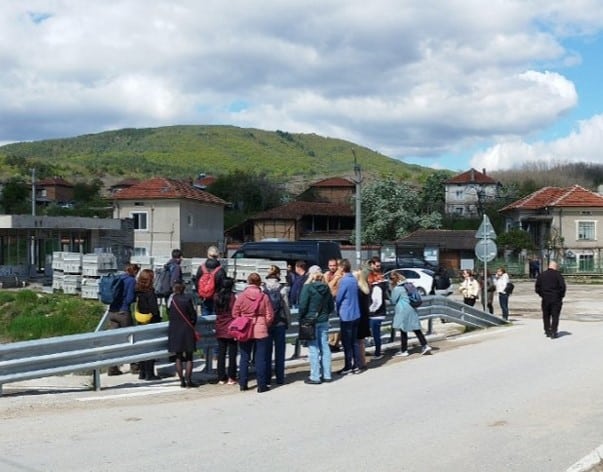
Participants examine local conditions during the ARCADIA study visit in Karlovo Municipality, where discussions explored how Nature-based Solutions could support longer-term flood resilience.
Learning goes both ways
ARCADIA’s distinction between ‘Model’ and ‘Fellow’ Regions does not mean expertise travels in only one direction. The exchange between Centru in Romania and Emilia-Romagna in Italy is a good example.
Romanian partners were particularly interested in Emilia-Romagna’s approach to financing ecosystem services and modelling flood risk. In return, Emilia-Romagna wanted to understand Romania’s experience of long-rotation forest management. During the study visit to Romania, participants explored how forests can remain productive while also supporting biodiversity and climate adaptation. The exchange continued in June, when the Romanian delegation visited certified public forests, the Ridracoli water system and an active harvesting site to see how forest management can balance ecological priorities with economic use and hydrogeological protection.
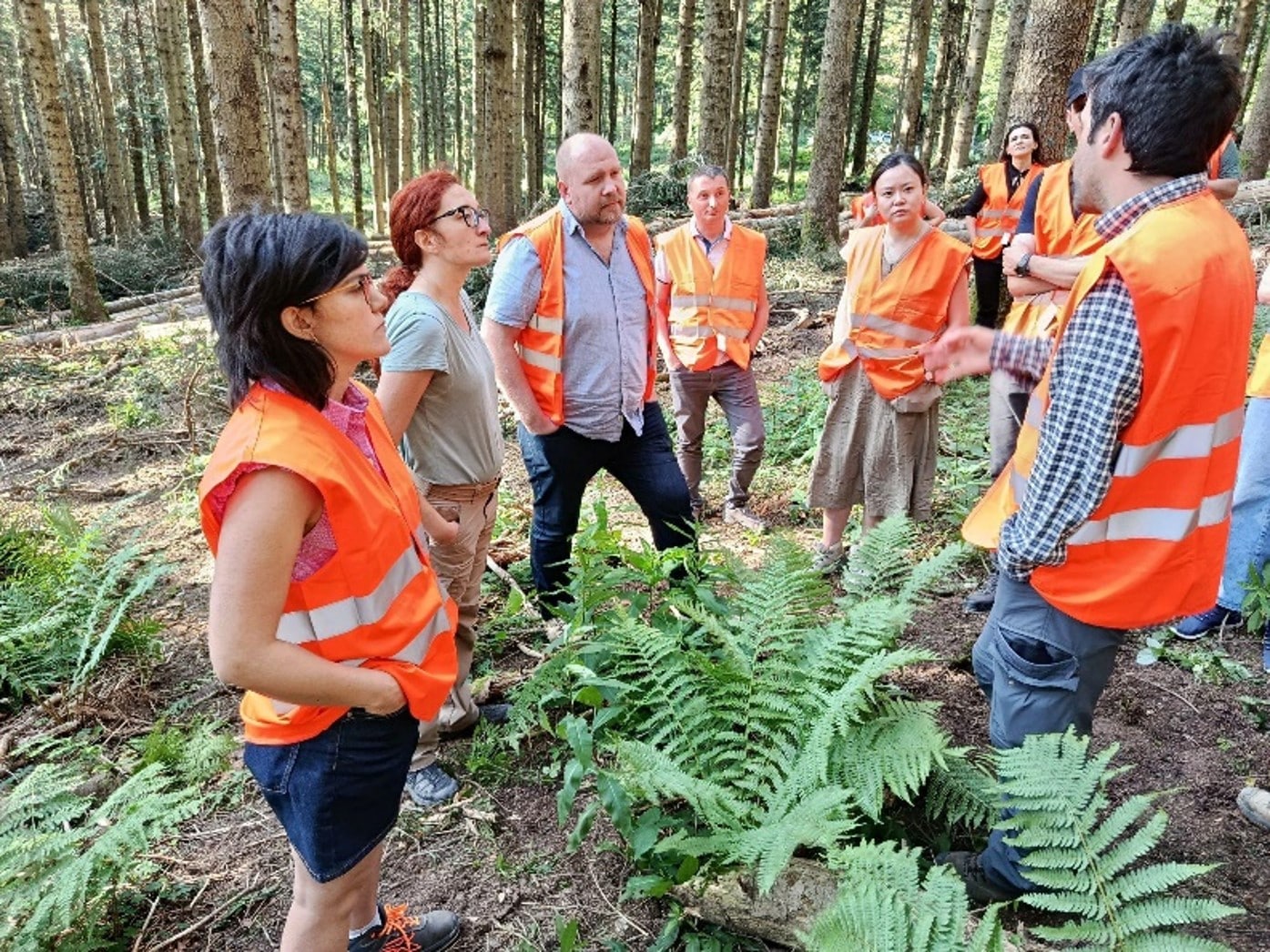
Partners explore forest management in Romania during the Centru–Emilia-Romagna twinning exchange in November 2025.
The point is important – places are not divided neatly into those with solutions and those that need them. Every region has knowledge that may be valuable elsewhere.
Designing learning, not just visits
Of course, study visits alone do not guarantee useful learning. As part of Climate KIC’s contribution to ARCADIA, colleagues have supported regions throughout the process, from preparing the exchanges and defining shared priorities to helping participants reflect on what they learned afterwards through ARCADIA’s Adaptation Journals.
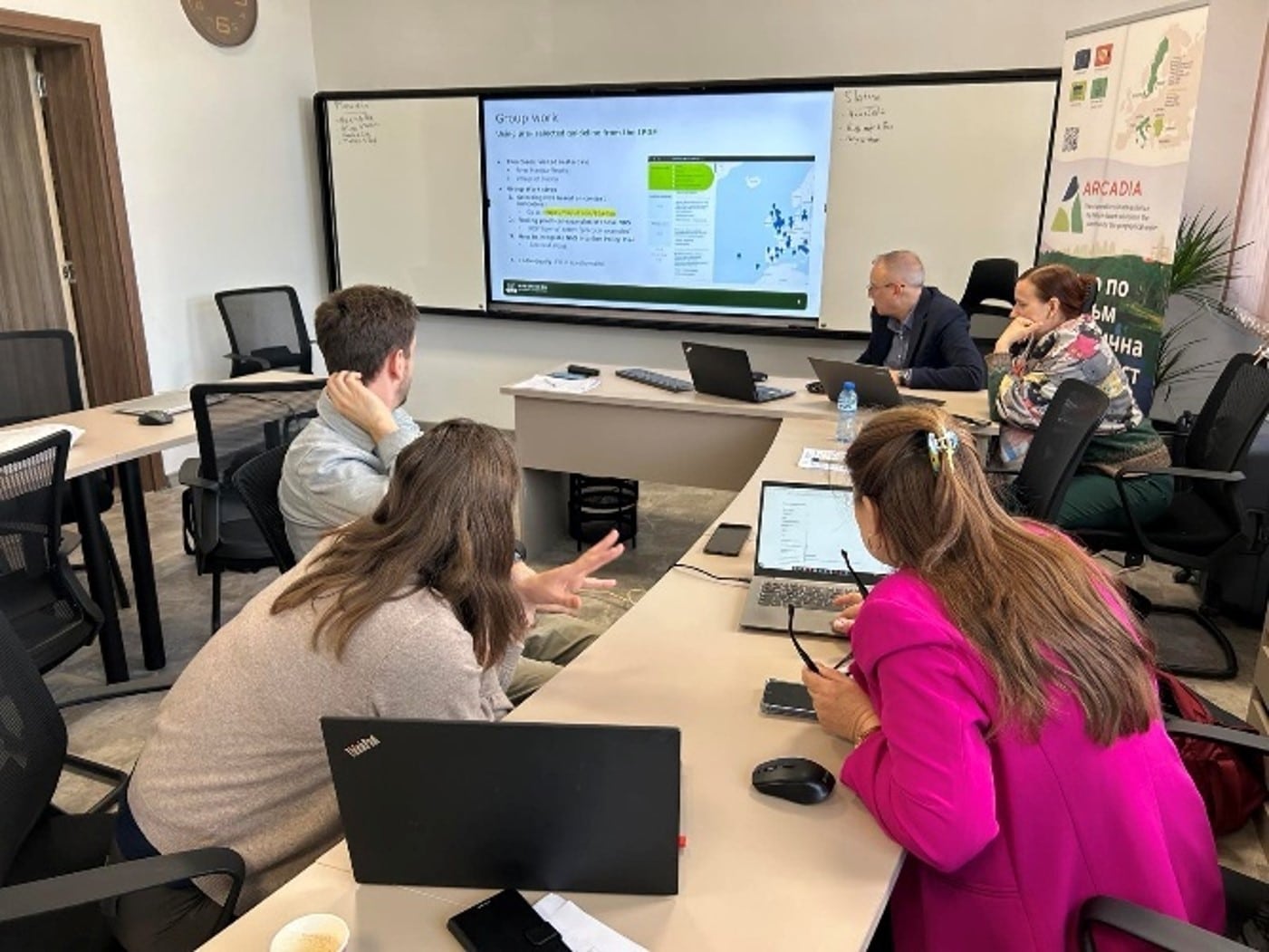
Participants work through how lessons from the exchange could be applied in Plovdiv during the April 2026 study visit.
That preparation matters because it turns a visit from a tour of interesting projects into a process built around specific questions. And the follow-up is equally important. It asks participants to consider what they saw, and what they might do differently in their own context.
“In ARCADIA, success isn’t about how many visits we organise or how many people take part. It’s about whether regions strengthen their capacity to create and sustain change. That means designing learning around outcomes: involving the right people, understanding what enables or blocks implementation, and making space for unexpected insights. The goal is less about replicating a solution, but building the capacity to adapt it successfully to a new context.”
— Celsa Monros, ARCADIA Lead at Climate KIC
Helping good ideas travel
The lesson extends beyond ARCADIA. European regions need to adapt quickly and working in isolation risks repeating mistakes and reinventing approaches that have already been tested elsewhere. But on the other hand, sharing solutions does not mean assuming they will work everywhere in the same form.
A more useful approach is to ask why something worked in the first place and what would need to change before it could work elsewhere. Climate resilience depends on the solution, but also on the relationships and learning processes that allow good ideas to travel.
ARCADIA’s second twinning phase continues until March 2027, giving participating regions time to turn these exchanges into practice. The real test for ARCADIA’s participating regions is whether they can turn what they have learned into something that works at home, rather than copy and paste the solution that worked elsewhere.