Changing tides: a shared vision for climate innovation for the Port of Piraeus in Greece
This report is an Outcome Story, a Climate KIC MEL initiative to share stories of systemic climate innovation. Find out more about our approach to evaluation and the methodology here.
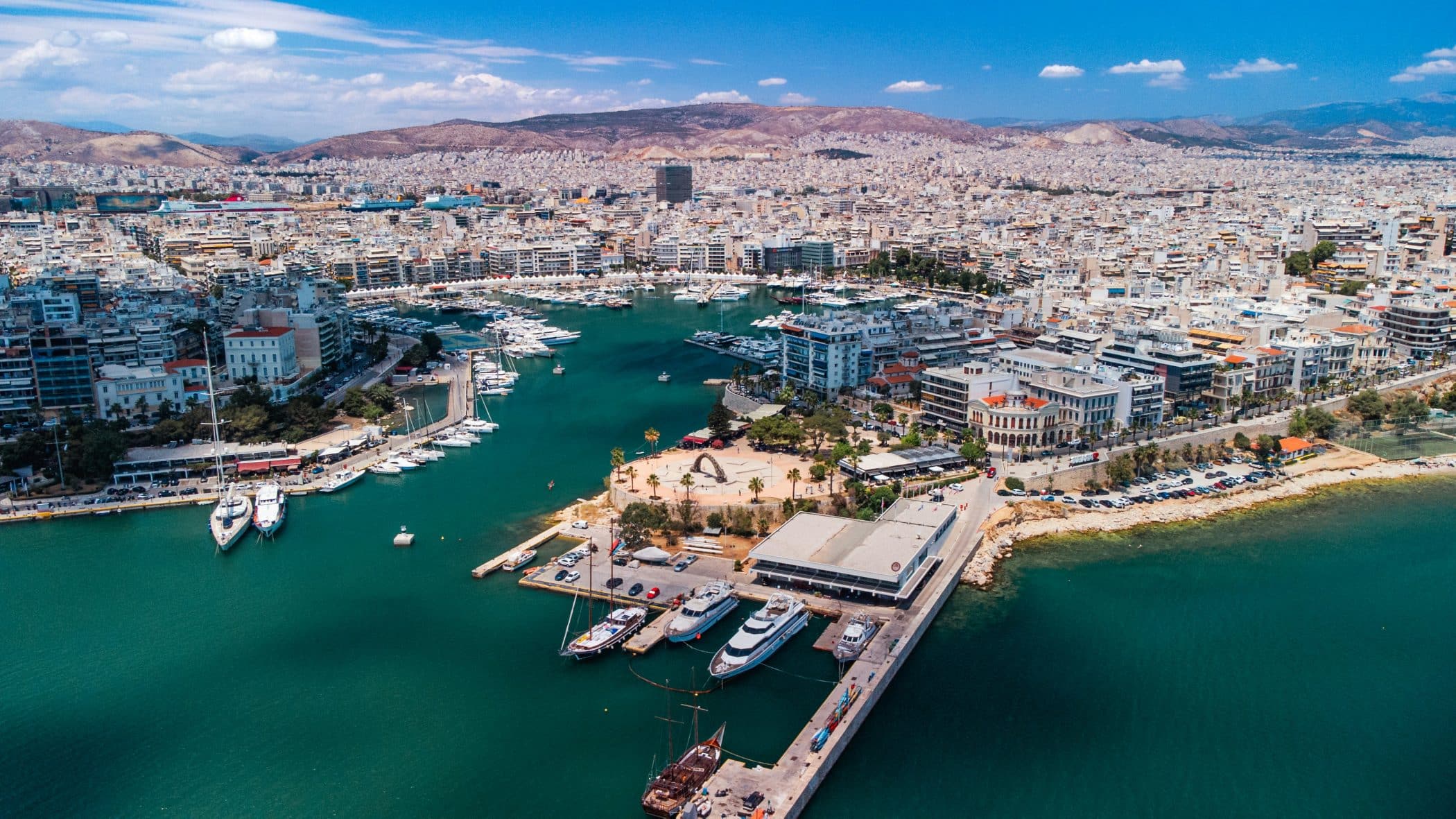
The Port of Piraeus is located at the crossroads of Europe, Asia and Africa, being the gateway to Athens since antiquity. Today it is a key commerce node, connecting the Mediterranean and Europe to the global logistics network. As a response to a range of climate and social challenges creating complexity and uncertainty in the environment the company operates in (digitalisation, climate change, ageing populations, increased societal pressure for climate action etc) – this vital hub partnered with Climate KIC to move beyond ‘innovation as usual’.
The Net-Zero, Resilient Maritime Hubs Deep Demonstration programme, designed by Climate KIC, emerged as a response to these interconnected challenges. Working on targeted stakeholder engagement, co-creation and open innovation, the Port Authority, together with the local Climate KIC community in Greece, developed a new, holistic vision and strategy for climate action, delivering concrete on-the-ground innovation and setting the foundations for long-term systemic innovation and collaborations.
We do not need to copy-paste and compare, but rather to take care of what we have and bring it to the next level: water the roots of the tree and wait for it to bloom.Maria Loloni Project Lead, Climate KIC
A foundation for trust and collaboration
Climate KIC’s project lead, Maria Loloni, observes that “the Port had indeed a powerful vision for its role in the wider ecosystem – however, key local and national actors had different aspirations, emphasizing the social and cultural significance of the Port for the local community, as well as the potency of the Port to be a key innovation driver for the country. The stakeholders had been discussing in smaller groups throughout the years, but never before did they have the opportunity to sit all of them together”. The project’s mission was also personal to her: Maria, born and raised in Athens, started her career studying maritime economics in the port city – spending countless hours among the public docks of the Port and adjacent marina, sometimes performing research, other times hanging around with friends. Similar to many locals, she still considers the Port of Piraeus a core part of her identity.
At the start of the programme, Climate KIC together with the local Greek partners developed a multidisciplinary roundtable in Piraeus. The purpose was to bring together different stakeholder groups who had influence / interest in the future strategic direction of the Port: representatives from the port’s strategy department, engineers, small enterprises in the blue economy, national research bodies, universities, non-profit foundations, representatives from the city and the Hellenic Republic Asset Development Fund (HRADF), a minority shareholder in the port. Additional stakeholders were mapped, to be gradually integrated in the process.
The collaboration was initially faced with scepticism by some: ‘why do we need a shared vision?’ was the question repeating across building corridors and online meetings. Very valid question: bringing all key stakeholders in the same room is not necessarily the standard process for developing new strategies and plans for an organisation. Soon, however, through regular meetings, facilitated workshops, trust-building exercises and the use of targeted tools for shared visioning and planning from Climate KIC’s Visual toolbox for system innovation, the group began to realise that the multiple challenges faced in today’s interconnected world can only be solved through capitalising on our collective intelligence and by working together towards a common goal.
Finding common ground and a new narrative of local innovation
This process was consciously designed not just to gather input and facilitate discussion, but to foster trust, build collective identity, and create a space for divergent opinions to be heard and reconciled. Using facilitation and adaptive learning, Climate KIC’s approach moved away from traditional stakeholder engagement to focus on co-creation, foresight, and emotional intelligence. Artistic approaches were also integrated in the process, allowing participants to dream and draw the future together, or use role-playing elements to understand diverse perspectives.
Grounding the process to respond to the group’s local realities and evolving needs was key. There were moments when participants might have been losing hope, contrasting local realities and economic conditions in Greece to other countries and port-cities which they considered ‘more advanced’; considering that they can never reach that level, so ‘what is even the point of trying, and not doing things according to business-as-usual’. That was when Climate KIC’s experienced facilitators introduced exercises to support the group regain its agency: think of successful local examples and realise that success is not replicating one-for-one, but building on the individual strengths of each local environment – doing your best with what is available. This helped the group shift their narrative from comparison to possibility.
Maria recounts: “Because I grew up Greece, I understand and share the mindset – and I think it’s important to acknowledge it: there are instances when we tell ourselves that we can never move into that ‘top gear’, no matter how hard we try. However, it is also important to acknowledge that locality-specific economic and social conditions spark innovation in diverse ways. I left Greece in 2024, to study and work abroad – my experience in various countries has taught me that there are beautiful pockets of innovation and unique ideas everywhere. We do not need to copy-paste and compare, but rather to take care of what we have and bring it to the next level: water the roots of the tree and wait for it to bloom. When we shared best practice examples in the group, coming from our own companies, associations, cities, villages, it actually made a big change – we realised the richness of Greece and how much there is to build on”
Importantly, the process also worked through conflict. Early group meetings were marked by tension: industry, academic and community representatives do not always share the same interests, and they definitely do not share the same technical language – ‘there were moments where we might have all been saying the same thing, but we would not even realise’ Maria recalls. Rather than avoiding these frictions, the programme embraced them, creating space for dialogue and mutual understanding.
A shared vision of tomorrow to guide today’s decisions
By the end of the year-long engagement, the transformation in the collaboration dynamics was palpable. Maria recalls one group member asking her in the final meeting: “How did you make us all, coming from different organisations, think as ‘one’? ” This question manifests what we call ‘radical collaboration’: when the stakeholders build a collective identity that complements and elevates their separate affiliations.
The group co-created a new vision for the port, moving away from a purely economic framing which saw citizens as customers to one centred on strengthening the well-being of the local community. At the same time, the barriers and enablers to innovation were identified across the spectrum (from policy and skills to finance and technology) and work in the Ports’ priority areas started with two simple, powerful actions, sparking collaboration and innovation:
- A climate hackathon (‘Climathon’) was organised by the Port and city of Piraeus, where participants worked on the shared challenge of waste management in the area
- matchmaking events connected blue economy startups from the MENA Maritime ClimAccelerator (supported by Climate KIC) with Piraeus and other Port authorities in Greece
Radical collaboration can underpin both public good and private sustainability
What’s more important about this process of deep, radical collaboration is that it became a reference point for the Port authority’s future actions. Projects working on shared adaptation pathways were sparked from this process (eg ARSINOE), while it inspired public authorities in Greece to commit to a new way of working: a few months later, Climate KIC and ATHENA RC were invited by the Hellenic Republic Asset Development Fund, shareholder of several ports in Greece, to work on a similar programme in the nearby Port of Lavrio. This shows the crucial role of public authorities and multiplier entities in the replication of best practices, acting as catalysts for change.
Guidelines for Systems Innovation for Ports
A similar process was followed in the Port of Lavrio: mapping local stakeholders and bringing them together through targeted meetings or public climate hackathons to work on a shared vision and solutions for the Port city. In the Lavrio case, strong emphasis was also put on how systems innovation supports meeting ESG and SDG targets, which are key impact measures for any business.
Drawing on the Piraeus and Lavrio cases, HRADF, Climate KIC and ATHENA subsequently authored ‘Guidelines for Systems Innovation for Ports’, explaining how the process can be replicated in any port. The publication of the Guidelines was complemented by relevant trainings organised by HRADF, which enhanced the understanding of the current policy, environmental and technological landscape and increased the systems innovation capacity of Greek ports.
Long-lasting impact
“When we initiated the Deep Demonstration programme in Piraeus a few years ago, it was somewhat ahead of its time; wide stakeholder engagement was encouraged, but not a requirement. Consultation was also performed in a different way: either through bilateral / small group / unstructured processes or public consultations in written form. Multidiciplinary, multistakeholder engagement is gradually becoming a key trend in the EU innovation landscape, to ensure all voices are heard and to enable a prosperous, inclusive, just transition. Times have changed considerably in the past years, and public and private stakeholders see the strategic value of such processes beyond compliance, as a long-term asset.” notes Maria.
Besides the more concrete, technical outcomes, Maria considers ‘mindset shift’ as one of the most significant outcomes for a key, long-lasting impact: thinking as one, supporting each other, striving for win-win solutions.
In fostering this shift, Climate KIC’s role was more than a ‘neutral coordinator’: the programme design was consciously rooted in the local reality, building trust to overcome initial scepticism and find common ground among diverse stakeholders and interests. Adapting the programme course every day was part of the process – you can never fully predefine how everything will work and what the group will need at each point in time. Combining elements of work and play, balancing on-paper analysis with live interactions, all play a role in building a shared course together, to make the system move faster. “Even when things do not necessarily go as planned, that’s ok – it’s the learning that counts; and learning never actually finishes.”