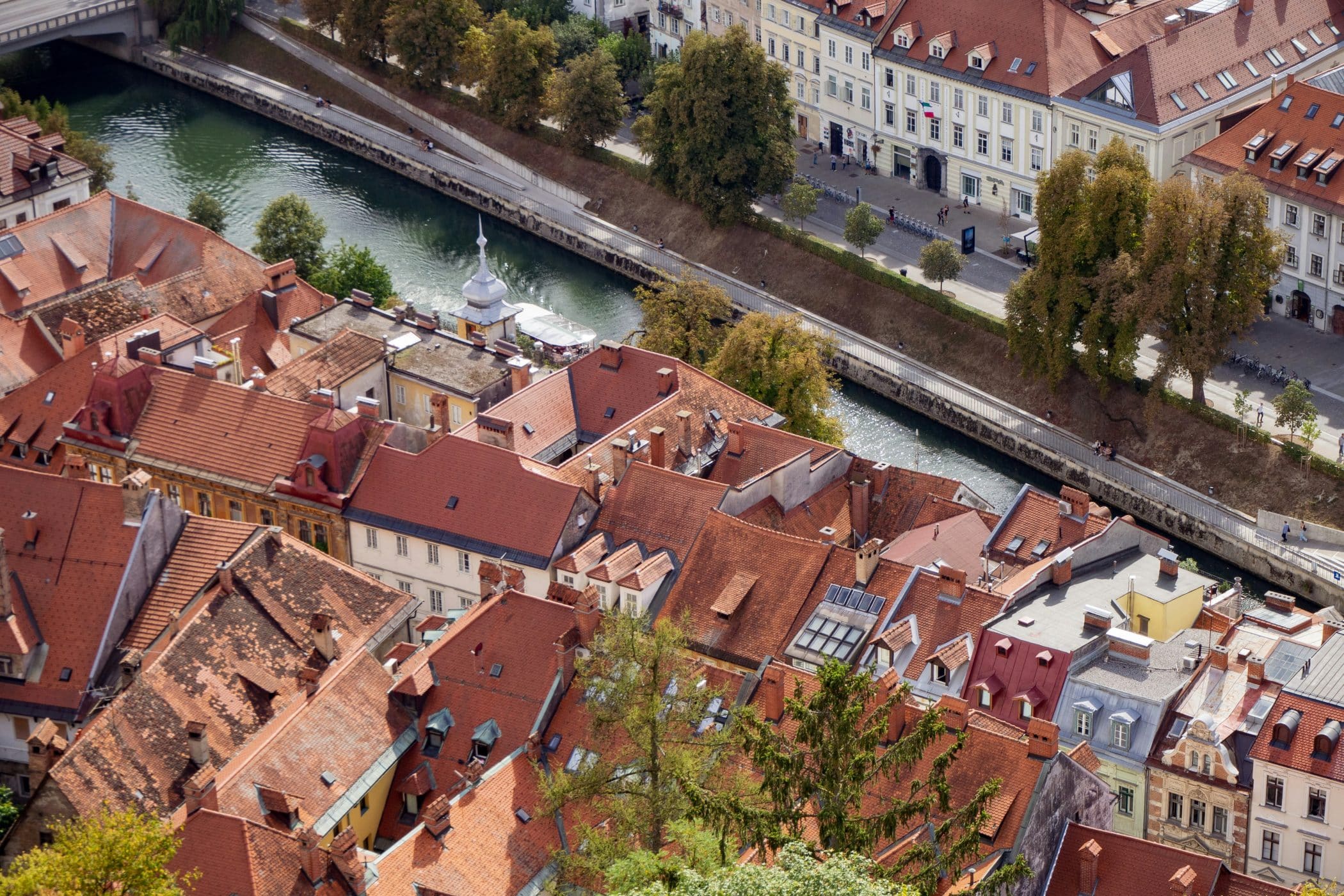
River running through Ljubljana, Slovenia from above
Outcome Story

A Slovenian Ministry going against the grain: Using a portfolio approach for decision making

This report is an Outcome Story, a Climate KIC MEL initiative to share stories of systemic climate innovation. Find out more about our approach to evaluation and the methodology here.

Decision-making in Slovenia, as with any government, is complex. It involves navigating interconnected policies, diverse stakeholder needs, and rapidly evolving social and technological landscapes. Decisions rarely exist in isolation; changes in one area, such as research funding or skills development, can ripple across institutions, industries, and communities. This complexity calls on leaders to let go of linear ways of working and step into a systems-learning mindset; learning as they go, experimenting, adapting, and collaborating across boundaries. Yet within public administration, where routines run deep and processes are built for stability, adopting this kind of agility can feel like swimming against the current.

However, just beside the Ljubljanica River, a place where currents meet and change direction, the Ministry of Higher Education, Science and Innovation (MVZI) decided to do things differently. With Climate KIC’s support, the Ministry began examining its own system with fresh eyes, mapping where old patterns held them back and where new possibilities could open.

Slovenia’s commitment to building a circular, regenerative, low-carbon economy had already brought the government into partnership with Climate KIC through the Deep Demonstration programme. It was during one of these project meetings in Ljubljana that we brought the portfolio approach to MVZI as a way to look at innovation not as isolated projects, but as a connected set of actions unfolding across entire systems.

The portfolio approach, already being used to explore change in areas like the built environment, food systems and mobility, offered a way to learn across initiatives, spot patterns and understand how systemic change actually happens. Immediately recognising its potential, MVZI began to see how this approach could help them work more cohesively with three of Slovenia’s universities, whose innovation programmes funded through the Recovery and Resilience Facility (RRF) were still being managed in a traditional, siloed project style.

These university-led initiatives were designed to support the National Resolution for Higher Education by strengthening green and digital skills and improving employability. The Ministry recognised, though, that if Slovenia was serious about transformation, these efforts needed to be understood as part of a wider system, not as stand-alone projects. Despite this ambition stretching beyond the original Deep Demonstration scope, Climate KIC agreed to provide support, seeing a rare opportunity to share a more connected and systemic way of thinking within a government ministry.

Making this shift real required commitment. MVZI began by investing significant time and resources into developing the portfolio approach as a new way to monitor and evaluate the RRF pilots, including creating a dedicated full-time role to carry the work forward. The Ministry already had a willingness to experiment, and with our assistance, the team began mapping observation areas to understand what was enabling, or holding back, deeper change within Slovenia’s higher education system. Trust built through the earlier collaboration with Climate KIC strengthened the process, and what had begun as a tool for tracking green and digital goals gradually evolved into a broader learning exercise, helping the Ministry see change in a more systemic, interconnected way.

As the work progressed, the analysis expanded beyond the initial scope to include all 38 pilot projects, covering topics such as micro-credentials, curriculum reform, and innovative teaching practices. Seen through the portfolio lens, the many separate initiatives began to form a coherent picture, helping the Ministry see both momentum and inertia. A good example being that some curricula were evolving toward sustainability while the institutions’ own practices had not yet begun to change.

The analysis led to a report that identified the gaps in the system, which were hindering the transition. Among these were the absence of deeper curricular reform and the impact of fragmented, short-term funding models. The report called for a more holistic and durable financing approach to be built into the next cohesion policy framework.

The work also opened new doors. It prompted a collaboration with the Ministry of Public Administration to run a policy lab on micro-credentials, which helped shape a new article in the Higher Education Law, now awaiting parliamentary approval. Micro-credentials are fast becoming an important route for building sustainable skills and supporting the green transition, while also representing a significant opportunity in the labour market.

Reflecting on the experience, a staff member observed that: “the portfolio process itself brought unexpected value. It changed the way we think, not only within my department but also in our exchanges with other ministries and universities. Personally, I hope we continue this approach as the report we produced is just the beginning. With more funding, we could evolve it into a recurring research method”.  The portfolio approach was seen as more than just technical monitoring. Through fostering reflection, dialogue, and cross-sectoral learning, elements often missing in traditional project management, it shifted mindsets and created meaningful change.

Beyond informing the new micro-credentials policy, the work also revealed important lessons about how change happens within universities, such as the ways teaching practices and incentives can enable or block curriculum reform. These insights became useful guidance for civil servants shaping higher education reform, as well as deepening understanding between the different groups involved.

Going forward

Despite the successes, sustaining the momentum from this process is precarious. The Ministry continues to operate a project-based funding structure which makes long-term continuity difficult. Traditional, siloed mindsets among other civil servants also anchor institutionalised ways of thinking, making change challenging. 

The portfolio work itself stayed largely within the Ministry. Although the analysis produced many valuable insights into how change occurs, the final report was not shared with the universities, as it was considered too sensitive. Without active engagement from higher education institutions themselves, progress will always remain partial. It is here that the tension at the heart of systemic work lies: transformation relies on openness, yet institutions often default to caution.

Still, the experience highlighted a different way forward. A portfolio-based, systems approach proved successful in this context and could be applied more widely across government, helping ministries see projects not as stand-alone efforts but as part of a broader transformation. Such an approach would allow strategies to better align with the realities of interconnected systems, whether in higher education, circular economy planning or skills development for the green transition. Applied at scale, it could strengthen Slovenia’s ability to navigate the complex waters of systemic change and support its ambition for a more regenerative, resilient future.

This idea is backed up by Marjana Dermelj at the Ministry of Public Administration who said that: “The systems transformation work that the Ministry of Higher Education, Science and Innovation undertook with their portfolio exercise – even though it is not entirely linked – could definitely support the process of decarbonisation and circularity. In addition, their work with Climate KIC on eGuide, eGlossary and green award for Higher Education Institutions can represent a small stone in the decarbonisation/circularity mosaic.”

The next step, already initiated through the Deep Demonstration, is to share these learnings with the Ministry of Cohesion and Regional Development to inform the next programming period of Cohesion Funds. If successful, MVZI and Climate KIC will have contributed towards a pivotal shift in how public funding is designed in Slovenia: moving beyond isolated projects toward portfolios that reflect the complex realities of innovation, systemic change and modern life.

Our approach to MEL