Outcome Story

A tale of two cities collaborating for a more circular approach to their textile industries: Enschede and Prato

How we work Our approach to MEL A tale of two cities collaborating for a more circular approach to their textile industries: Enschede and Prato

This report is an Outcome Story, a Climate KIC MEL initiative to share stories of systemic climate innovation. Find out more about our approach to evaluation and the methodology here.

Europe’s textile sector remains highly resource-intensive and wasteful: only 10% of textiles get recycled, and only 20% of consumers regularly buy used clothes. While cities are increasingly developing circular economy strategies, interventions relating to textile collection, sorting, repair, reuse, skills and consumer behaviour are often designed and implemented by different actors with limited coordination.

As a result, promising initiatives frequently remain isolated projects rather than becoming part of a coherent system-wide transition.  For local authorities, one challenge is understanding where interventions can have the greatest leverage across the textile value chain.

Without a common diagnostic tool, cities struggle to move from isolated pilot projects toward coherent, scalable circular strategies. The result is a pattern familiar across Europe, a portfolio of well-intentioned pilots that never scale into a strategy. 

The Circular Cities and Regions Initiative (CCRI) Twinning Programme

Under the Circular Cities and Regions Initiative (CCRI) Twinning Programme, Climate KIC designed and facilitated a peer-learning exchange between the cities of Enschede in the Netherlands and Prato in Italy. Both are textile cities, and both were examining how reuse and repair could contribute to circular economy goals. However, they faced different challenges and were at different stages in understanding how these activities connected to wider economic, social and environmental objectives.  

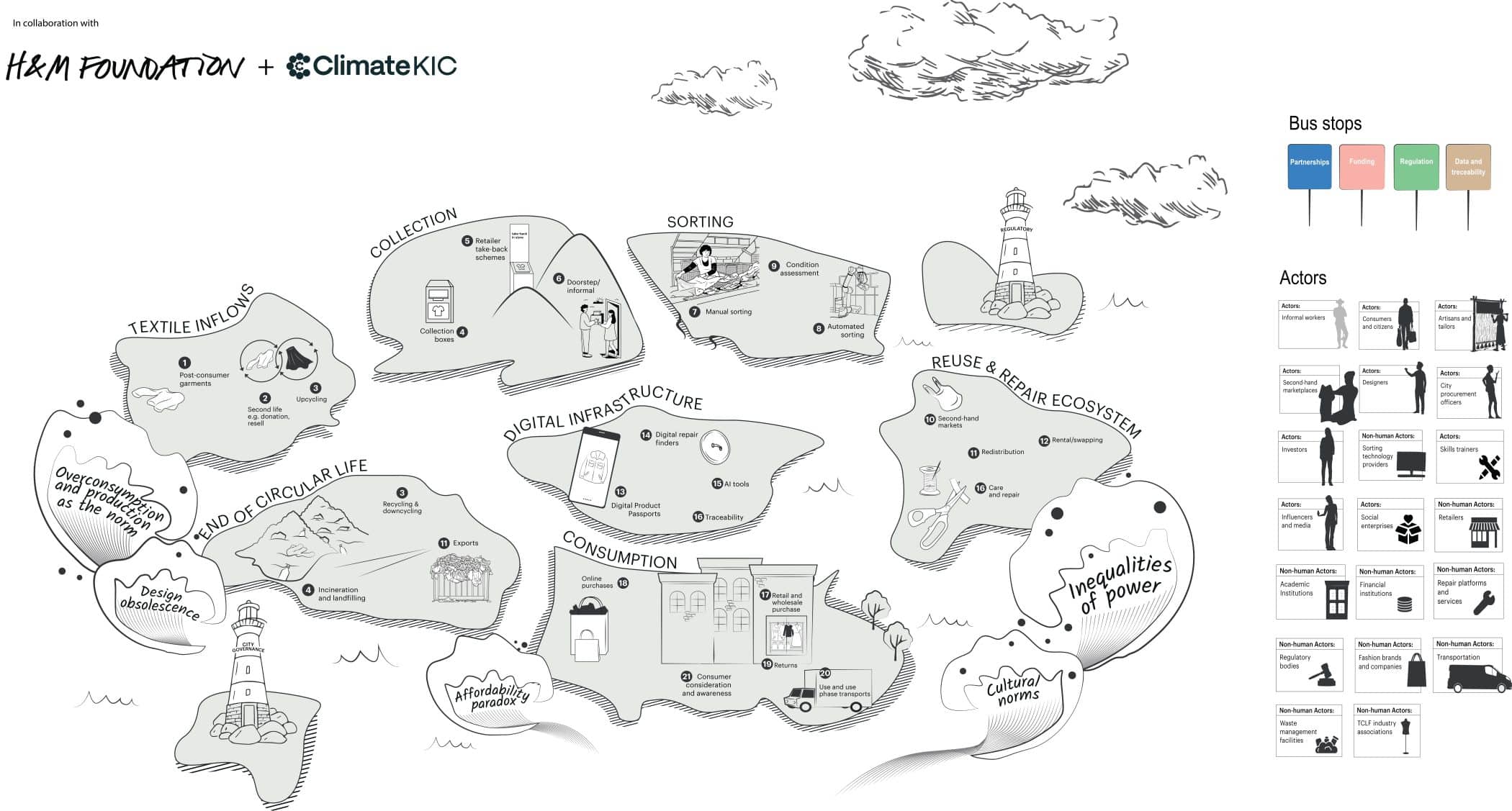
Climate KIC’s role was to broker knowledge between sectors and translate existing expertise into a practical decision-making tool for cities. Drawing on a system map originally developed by H&M Foundation, Climate KIC adapted the framework for municipal and regional use and designed a facilitated exchange around it.  

Through the workshop, Climate KIC helped both cities analyse their local textile ecosystems, identify areas of opportunity and reflect on where greater coordination could strengthen circularity efforts. The insights generated were owned by the cities themselves; Climate KIC provided the process, structure and facilitation that enabled them. 
What changed

Both cities came out of the session describing their reuse and repair work differently from how they had described it going in. 

Prato reframed repair and reuse as a cross-cutting strand of its circular economy strategy, spanning economic development, social inclusion, skills, innovation and citizen engagement, rather than a waste stream to be managed. The city also named specific gaps in coordination between actors that it intends to address.  

Enschede used the mapping exercise to look at the shape of its own portfolio, and found its efforts concentrated on some parts of the textile value chain considerably more than others. That imbalance had not been visible until the map made it visible.  

Both cities then pointed, independently of each other, to uses for the tool beyond the session itself. Prato sees it supporting cross-departmental collaboration and the design of future funding proposals. Enschede plans to use it internally, as a way of explaining circular value chain complexity to managers and to aldermen.  

Both also valued the exchange itself. Comparing two different local contexts surfaced shared opportunities and perspectives that neither city had reached alone. 

Lessons learned

Industry and cities usually solve circularity separately. Here, they didn’t.  

Diagnostics built for industry rarely make it into public administration, and tools built for public administration rarely draw on industry thinking. The result is two parallel efforts: corporate sustainability strategy on one side, municipal circular economy policy on the other, that talk about the same value chain without ever mapping it together.  

Climate KIC’s adaptation of the System Map for city and regional use shows a version where that doesn’t have to be the case: a diagnostic built inside the fashion industry, translated into a tool two municipalities used to rethink their own strategy from the inside. 

The same map did different work for each city, and was useful in both.  

The diagnostics tool helped local actors understand how different parts of a textile system interact and where collaboration may unlock greater impact. Rather than prescribing technical solutions, Climate KIC equipped the cities with a systems lens that enabled them to make more informed strategic decisions, tailored to their unique context. 

The cities identified uses for the tool beyond the learning sessions themselves.  

Perhaps most importantly, both cities identified practical uses for the approach beyond the workshop itself, including cross-departmental collaboration, stakeholder engagement and funding proposal development. While a single workshop does not create systems change, it can equip local actors with new ways of seeing and navigating the systems they are trying to transform. 

Looking forward

The twinning model offers a ready way to do exactly that. Cities and regions interested in applying the same approach can download the adapted map and a simple guide on how to use it. 

Download the map

Download the guide

Our approach to MEL