
Building credibility and value for Europe’s carbon farming transition
Authors
| Daniel Zimmer Director of Sustainable Land Use, Climate KIC |
Sonia Pietosi LILAS4SOILS Coordinator, EIT Food |
| Tristano Bacchetti De Gregoris Project Credible Coordinator | Founder, SAE Innova |
Saskia Keesstra Designer and Producer in Land Use Transformation, Climate KIC |
As Europe prepares for the 3rd European Carbon Farming Summit, which will take place in Padua, from 17–19 March 2026, now is the moment to look back at the lessons and priorities that emerged from last year’s Dublin summit. Both in person and online, the 2025 event brought together over 1,000 farmers, policymakers, researchers, and businesses to share lessons learnt and shape a credible, inclusive approach to carbon farming in Europe. Across 41 sessions, participants produced 165 recommendations – a unique snapshot of stakeholder priorities as Europe begins implementing the Carbon Removal and Carbon Farming Regulation (CRCF).
Eight messages from the field
The recommendations reveal a maturing conversation – one that moves beyond pilot enthusiasm to the practical conditions for credible and equitable carbon farming credits.
1. Simplify access for small farms
Small and medium-sized farms are at the heart of Europe’s rural fabric yet remain disadvantaged by complex and costly Monitoring, Reporting, and Verification (MRV) requirements. Participants called for simplified methodologies, pooling mechanisms, and landscape-based approaches that lower transaction costs and make participation in the emerging carbon market viable for all.
2. Ensure real value for farmers
The carbon farming credit market will only thrive if it offers a fair return on effort and risk. Current carbon credit prices remain low relative to the costs of monitoring and low compared to common agricultural policy (CAP) subsidies. Stakeholders of the summit emphasised the need to blend carbon revenues with other incentives and subsidies to make regenerative transitions economically sustainable.
3. Adopt holistic approaches
Carbon farming must go beyond carbon. Participants stressed integration with biodiversity, soil health, water, and rural resilience goals, warning that a narrow focus on carbon sequestration could undermine wider sustainability and resilience ambitions.
4. Share financial risk fairly
A recurring theme was risk equity – ensuring that farmers are not left to shoulder market, permanence, or implementation risks alone. At the same time, companies and financiers investing in carbon farming also face significant exposure, from the financial risk of underperforming projects to reputational concerns linked to environmental integrity. A more balanced system will require shared mechanisms, such as buffer pools, pre-financing arrangements, and supportive policy instruments, so that responsibilities and risks are distributed fairly across the value chain.
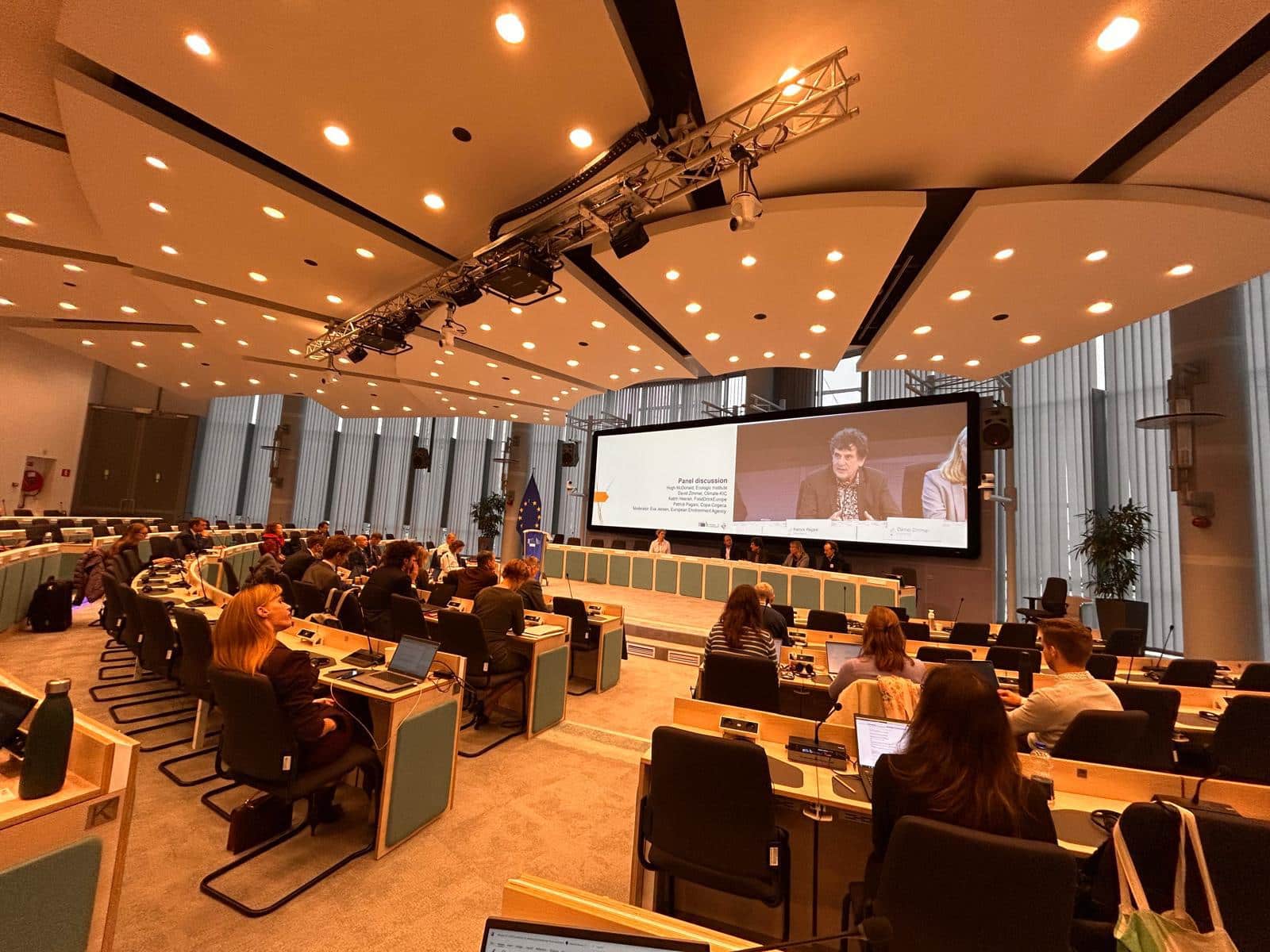
Daniel Zimmer in Brussels sharing recommendations from the second summit, as part of a dialogue on agriculture facilitated by the Danish Presidency of the European Union, November 2025.
5. Clarify offsetting and insetting rules
A concern from agribusinesses and value-chain actors is the lack of clarity on how the same carbon farming activity should be treated when it could theoretically contribute to both insetting (value-chain emission reductions) and offsetting (credit-based claims). Clear differentiation and harmonised rules are needed to ensure that certificates are used appropriately and that double claiming is avoided. More broadly, coherence between the CRCF, the GHG Protocol and the Science Based Targets initiative (SBTi) will be essential for market confidence and for companies seeking to account for value-chain climate action.
6. Support first movers while defining baselines
How can we ensure that those farmers who implemented carbon farming practices without the participation of climate finance do not feel penalised? Stakeholders called for smarter and dynamic baseline design that acknowledges early action and reflects Europe’s regional diversity.
7. Recognise regional differentiation
Soil carbon potential and mitigation options vary widely across Europe. Future policy and MRV tools must reflect this diversity, enabling region-specific pathways rather than one-size-fits-all rules.
8. Strengthen policy coherence
Perhaps the strongest message: align policy frameworks – from the CAP to the CRCF to national climate plans – so that farmers receive consistent signals and coherent incentives.
From recommendations to reality
The discussions in Dublin made clear that Europe is entering a new phase of the carbon farming journey. Early enthusiasm for demonstration projects and certification systems is now giving way to questions of governance, investment, and long-term market credibility.
In 2026, attention will turn to implementation: how to create markets that are trustworthy, financially viable, and fair? The upcoming summit in Padua will build directly on these insights, exploring the mechanisms and partnerships needed to translate policy intent into tangible outcomes for both farmers and land managers, and business leaders willing to finance climate action.
Themes such as finance and investment, robust yet practical MRV, clarity over ownership and rights, and integration of carbon with wider environmental goals will take centre stage. What unites these is a shared recognition that credibility is the foundation of scale: without trusted rules, clear incentives, and consistent data, carbon farming cannot become a mainstream part of Europe’s climate strategy.
Looking ahead to Padua

View over the centre of Padua, the host city of the 3rd European Carbon Farming Summit.
Europe’s ambition to decarbonise its land sector will only succeed if carbon farming delivers measurable impact, genuine value for farmers, and public trust. The Padua summit will bring together the communities driving this transformation – those designing policy, innovating technologies, and implementing solutions on the ground.
It will be a moment to take stock of progress under the new Carbon Removal and Carbon Farming Regulation, to learn from real-world examples, and to define how markets and policies can reinforce one another.
Registration for the 3rd European Carbon Farming Summit is now open.
Join us in Padua to help shape the next steps for credible, farmer-centred carbon farming in Europe.