Towards climate-neutral agriculture: System insights from ClieNFarms

Interested to find out more about the ClieNFarms project? Click here to register for the final webinar and workshop!
Europe’s agricultural transition is entering a decisive phase. With the newly adopted Implementing Regulation under the EU’s Carbon Removals and Carbon Farming (CRCF) framework, the Union is taking its first steps toward a voluntary certification system that will shape how soil carbon, carbon farming measures and land-based removals are recognised. At the same time, farmers across Europe face increasingly unstable conditions, while value chains, advisors and policymakers all work under their own measurement rules, incentive structures and risk constraints.
Amid these pressures, a deeper structural challenge becomes clear as the systems designed to measure, finance and incentivise agricultural climate action do not yet align. This misalignment shapes what farmers can adopt, how companies invest, how advice is delivered and how progress is counted.
Over the past four years, the Horizon Europe-funded ClieNFarms project¹ has served as a diagnostic tool for understanding these system interactions. Through its role in the project, Climate KIC helped bring together local farm experimentation and broader system-level analysis, revealing across twenty demonstration environments and more than one hundred outreach and replication farms where climate actions falter, where they succeed and what this means for Europe’s next steps.
1. Climate action breaks down when evidence, incentives and advisory systems move in different directions
ClieNFarms showed that climate measures only scale when the surrounding system pulls in the same direction. Through the project’s Innovative Systemic Solution Spaces (I3S), farmers, advisors, researchers and supply-chain actors tested climate solutions in the conditions where agricultural decisions are actually made. This made clear that adoption depends not only on technical performance but also on whether farmers receive coherent advice, whether markets reward their effort, whether policy signals remain stable and whether financial actors help share risk.
Across the I3S network, even well-designed solutions faltered when evidence, incentives and advisory guidance diverged. Conversely, when these factors aligned, farmers were more willing to experiment, invest and sustain change. This systemic dependency is one of ClieNFarms’ most significant findings.
2. Co-creation strengthens the conditions for real adoption
The project demonstrated that many farm-level decisions hinge on relationships as much as data. ClieNFarms’ co-creation structures – particularly the Creative Arenas – allowed farmers, advisors, processors, researchers and local institutions to explore climate options together.
As Creative Arena manager Deirdre Hennessy noted, the strength of these sessions lies in how they change the way people listen. Farmers involved in ClieNFarms said the workshops helped them see established routines from new angles and understand how decisions connect across the wider system.

Climate KIC’s Daniel Zimmer at the ClieNFarms final conference, Brussels, November 2025. Photo: © Rafaël Thorel, INRAE.
3. Indicators point in different directions, complicating how progress is defined
ClieNFarms’ technical work highlighted a fundamental problem in agricultural climate policy – progress looks different depending on the indicator chosen. The project identified around thirty climate measures, each affecting emissions, soil, carbon sequestration, resilience and biodiversity in different ways.
Indicators used per unit of product support supply-chain reporting but can encourage intensification. Indicators per hectare assist regional and policy planning but may favour extensification. Farm-level indicators reflect how farmers manage systems but do not easily translate into value-chain metrics.
ClieNFarms found that these perspectives frequently evolve in different directions for the same practice. This divergence makes it harder to define progress in a way that is meaningful across farms, markets and EU policy frameworks.
Assessments are needed that value both short-term mitigation outcomes and longer-term resilience. For example, a measure that improves soil structure may not deliver immediate emission reductions but still enhances the system’s capacity to withstand climate impacts.
4. Soil carbon modelling holds promise, but confidence depends on data quality and usability
The project’s work on soil carbon modelling highlighted both potential and uncertainty. Models can provide valuable insights into carbon sequestration, yet their reliability depends heavily on input data. Sampling methods, calibration processes and local variation all influence results. Many of the issues raised by practitioners stemmed not from the models themselves but from how they are applied.
Clearer guidance, more consistent datasets and user-friendly tools are central to making modelling accessible to farmers, advisors and institutions. This is particularly relevant as soil carbon gains increasing prominence in European policy – valued not only for mitigation but also for its role in soil function and water retention. Strengthening data governance and model usability will be essential as the CRCF begins defining carbon farming methodologies from 2026 onward.
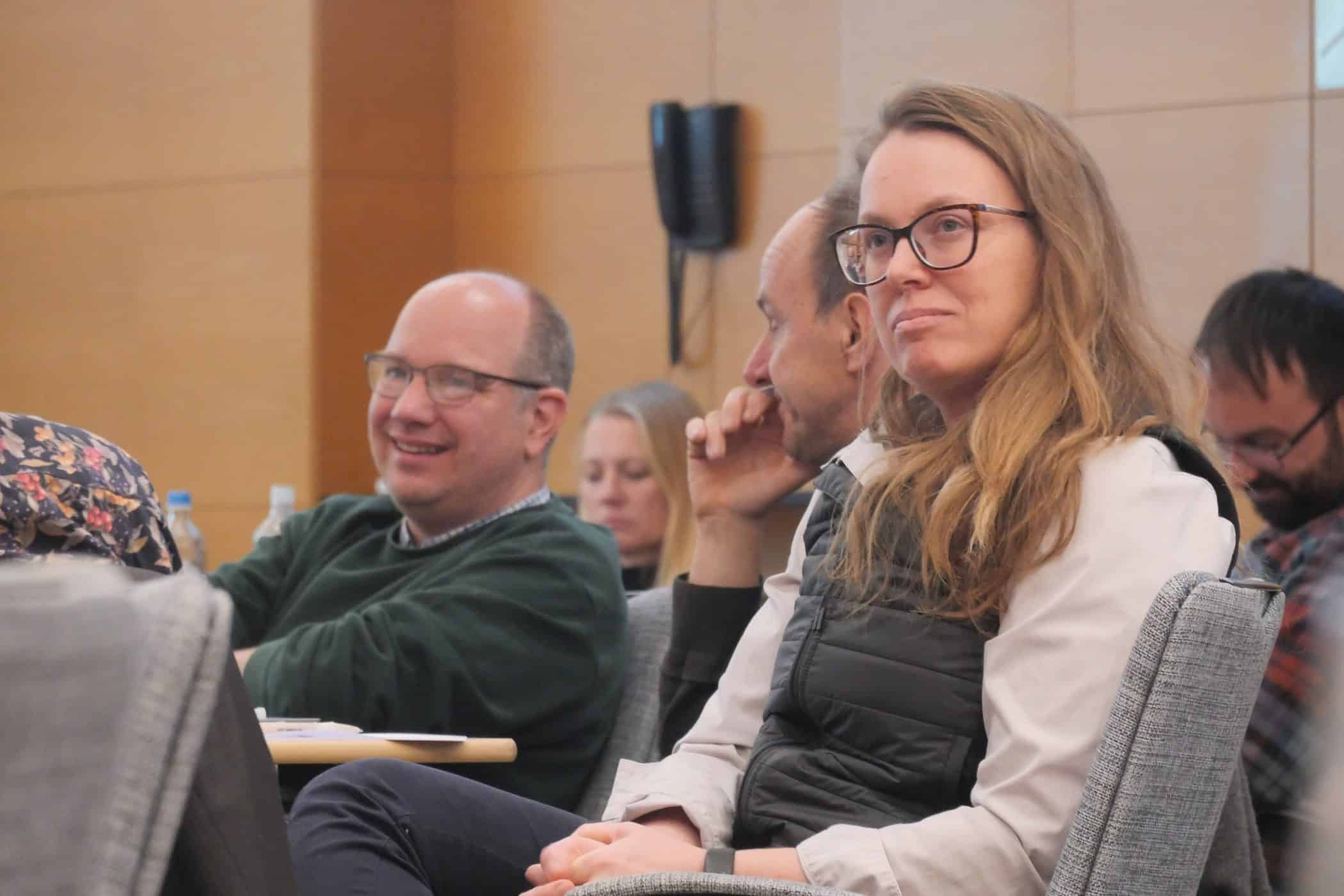
Photo: © Rafaël Thorel, INRAE.
5. Value-chain allocation remains a major barrier to private investment
ClieNFarms repeatedly surfaced a problem that is well-known but poorly resolved – climate benefits from farm practices are difficult to attribute across multiple outputs. Rotations, manure flows, livestock interactions and soil improvements create overlapping effects across value chains.
Companies need confidence about where climate benefits originate and how they should support them, yet current systems do not offer a practical or trusted way to allocate these effects. As a result, large-scale engagement from food companies remains constrained. Without a clear and accepted allocation framework, many firms hesitate to embed climate improvements into procurement and reward structures.
6. Farmers are asking for clarity, examples and shared risk
Across the project, farmers consistently asked for practical clarity, including clear instructions, tested examples, demonstration farms and advisory support that reflects local conditions. Concerns frequently centred on costs, uncertainties and the additional workload associated with transitions. Shared risk-management across supply chains therefore emerged as crucial.
Policy predictability was raised repeatedly. When accounting rules or reporting expectations shift, long-term planning becomes difficult for farmers and companies alike. The European Commission’s Directorate-General for Climate Action (DG CLIMA) reflects this concern. Valeria Forlín, for example, has emphasised the Commission’s openness to insights from ClieNFarms, particularly around soil carbon, which she noted contributes to both mitigation and resilience. This is now especially relevant as certification schemes prepare to apply CRCF methodologies once they are introduced in 2026.
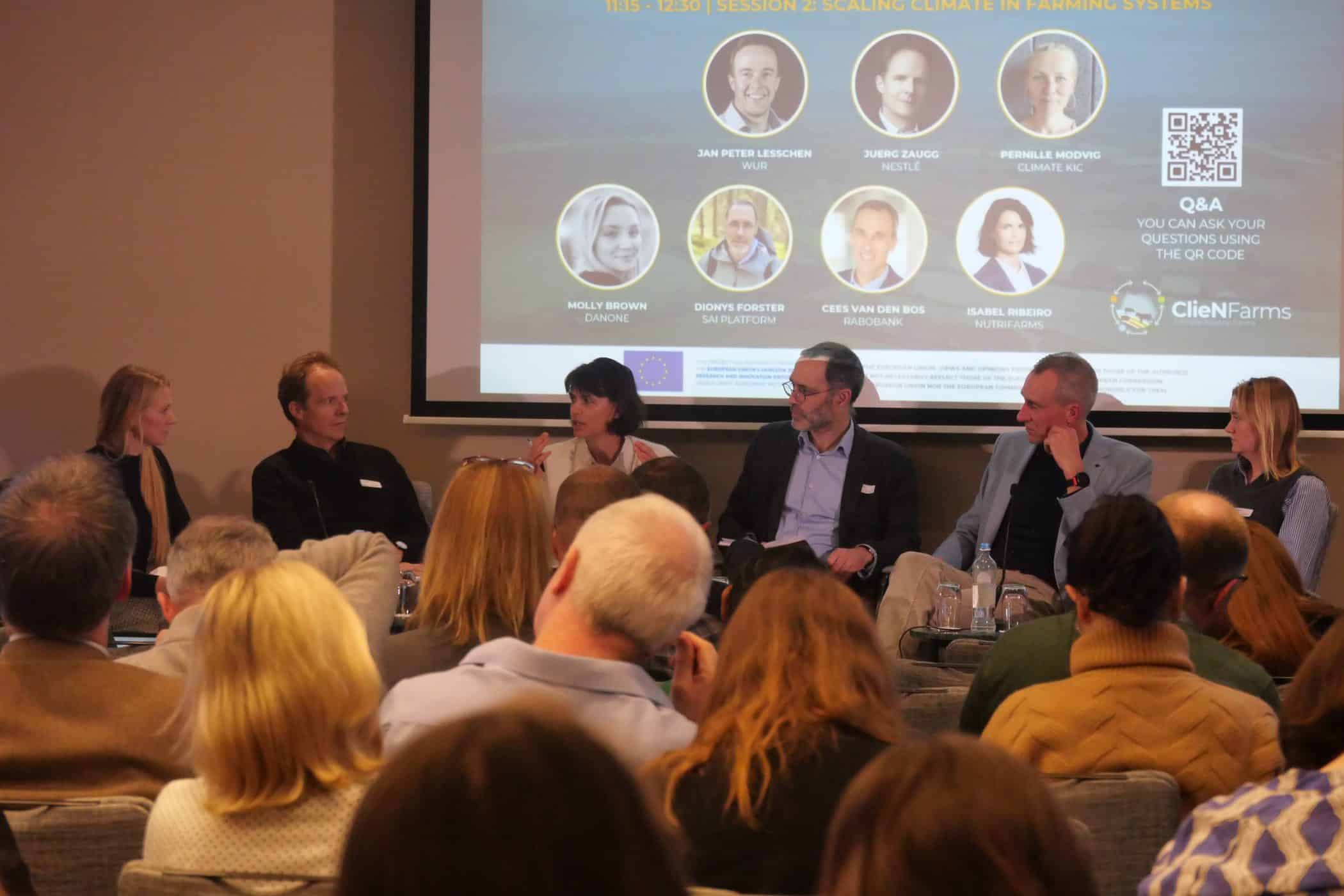
Climate KIC’s Pernille Modvig moderating a panel discussion at the ClieNFarms final conference. Photo: © Rafaël Thorel, INRAE.
A foundation for Europe’s agricultural transition
ClieNFarms leaves behind a substantial base of evidence, tools, case studies, policy briefs and co-creation methods. But its most important contribution is the clarity it provides about the systemic conditions that enable, or obstruct, climate-neutral farming. The project has shown where progress is possible, where structural barriers persist and how different parts of the agricultural system influence one another.
As the EU rolls out the CRCF framework and prepares new methodologies for carbon farming, the findings from ClieNFarms offer timely guidance. They point to the need for coherent advisory structures, clear evidence standards, stable policy signals and financial mechanisms that share risk more fairly across value chains.
Climate-neutral agriculture will require practical innovation and stable frameworks that reflect the realities of farm businesses. ClieNFarms has helped define how these elements can be aligned – and what Europe must address next to ensure that ambition is matched by workable, trusted and farmer-centred action.
Interested to find out more about the ClieNFarms project? Click here to register for the final webinar and workshop!
Join the movement for resilient, regenerative food systems
We’re building a movement for resilient, regenerative food systems by bridging the gap between policy, innovation and practice. From supporting farmers in adopting climate-smart agriculture and renewable-energy solutions, to facilitating dialogue between policymakers and practitioners at the European Carbon Farming Summit, Climate KIC is demonstrating that sustainable agriculture is practical, scalable and economically viable.
Whether you’re a farmer pioneering new practices, a researcher developing innovations, an organisation committed to climate action, or a supporter interested in transforming food systems around the world, we want to hear from you. Visit our #FoodFutures hub to learn how you can partner with us – and join our dedicated Farmers Network to shape the future of agriculture.
¹ ClieNFarms was coordinated by the French National Research Institute for Agriculture, Food and Environment (INRAE), alongside a consortium of 33 partners, including Climate KIC. The project received funding from the European Union’s Horizon 2020 Research and Innovation Programme under grant agreement no. 101036822.